Durante la seconda guerra mondiale il direttore della National Gallery di Londra, Kenneth Clark, leggendo il giornale, scopre un articolo a lui destinato. Si tratta della lettera di un lettore che gli lancia un appello. “Potrebbe riaprire le porte del museo, chiuse a causa dei bombardamenti tedeschi?”
Certo, sarebbe molto pericoloso per le opere ma il direttore è colpito da questa richiesta. “È proprio a causa della guerra che abbiamo bisogno di vedere delle belle cose”, pensa il direttore.
Come fare? La National Gallery, come gli altri musei, ha svuotato le sale d’esposizione. Ha poi nascosto le sue opere in una miniera abbandonata nel Galles. Questa precauzione si è rivelata efficace perché dal 1940 nove bombe sono cadute sull’edificio della National Gallery. Di fronte al pericolo, il museo non può ovviamente essere riaperto.
Ma i londinesi hanno bisogno di conforto e Kenneth Clark prende una decisione inedita: fa arrivare tutti i mesi un’opera di nascosto. Questa operazione è svolta seguendo dei criteri di massima sicurezza, in modo che il “quadro del mese” non rischi nulla. Due assistenti restano in prossimità e al minimo segnale di allerta sono pronti a evacuarla. Tutte le notti, l’opera viene messa in una stanza sotterranea chiusa con porta di acciaio e con combinazione.
Con grande stupore di Clark, il pubblico si presenta all’appuntamento mensile e questa iniziativa dura fino alla fine della guerra. Dei quadri di Tiziano, Velázquez, Renoir e molti altri pittori, fanno andata e ritorno per scaldare l’animo dei londinesi. Come dice l’autore della lettera, “è rischioso, ma ne vale la pena!”
When I hear about curfews, dark times come to my mind, times of war. Actually we have been fighting a war against Covid since March this year. There are no bombs, we don’t have to be evacuated, we can eat every day because there are enough food supplies. But the curfew has changed our habits, most probably also those related to meal times.
From North to South of Europe we eat at different times. Soon in the north, later in the south. Maybe you are invited to dinner by someone and the curfew forces you to eat earlier because then you have to go home. Or you eat later because you finish work late and don’t have time to buy something for dinner, or to stop by in a restaurant. The restaurants are closed, they only offer take-away service and you must go back home within the time set by the curfew.
A friend from Paris, before the city was put into total lockdown, had to return home by 9 p.m. We know that Paris is a big city and people often use public transport, which is very efficient. To be home by 9 p.m., she had to take the subway by 8:30 pm at the latest and therefore she was eating later than her previous habits. And she began to sleep badly.
If you make an appointment before the curfew begins, you may feel stressed out because you will have to rush to get home on time. Perhaps it would be better to stay at home and respect the government’s directions and limit our social contacts. But sometimes you want to be out for a while, to meet some friends.
The effects of the curfew are not only on your social life, but also on your health as a result of adapting to a new pace of life and changing your routine.
The new schedule imposed by the curfew may have advantages, for example, you stop working earlier, go home earlier and have dinner earlier. For example, you arrive home at 7 p.m., have dinner between 8 p.m. and 8.30 p.m., go to bed around 11 p.m. and get up at 7 a.m. the next day.
This would be optimal for your health. Indeed, you would better synchronize with your internal, external environmental and external social biological clocks (time).
Internal time is what marks your endogenous rhythm, which helps you sleep at night, stay awake during the day and eat at the right time for you.
External environmental time is determined by the alternation of the phases of light and dark generated by the solar cycle.
External social time can alter these balances. If your working schedule, lunch, dinner and leisure are not suitable to your biological type (chronotype) you could enter a phase of temporal disruption that may cause several health problems, like insomnia.
Our ancestors got up with the light and went to sleep with the dark. This rhythm allowed for adequate production of melatonin (the hormone that regulates sleep), which allowed for a perfect balance between internal time and external time.
The habit of eating around 9:30 p.m. or even later goes against these natural cycles and makes it more difficult to rest well. A large dinner ending around midnight could cause difficult digestion at a time when the body should be resting instead.
It is therefore recommended to finish dinner at least two hours before going to bed to avoid poor quality sleep and an awakening marked by fatigue, irritability and low cognitive performance.
If you follow the biological rhythm of your body, you will have a big improvement in your overall health!
Quando sento parlare di coprifuoco mi vengono in mente tempi oscuri, tempi di guerra. Ma in effetti quella contro il Covid é una guerra. Non ci sono le bombe, non dobbiamo essere evacuati, possiamo mangiare tutti i giorni perché ci sono scorte alimentari che non finiscono. Ma il coprifuoco ha cambiato le nostre abitudini, probabilmente proprio quelle legate agli orari dei pasti.
Da nord a sud dell’Europa si mangia ad orari diversi. Presto al nord, piú tardi al sud. Magari sei invitato a cena da qualcuno e il coprifuoco ti costringe a mangiare prima perché poi devi rientrare a casa. Oppure mangi piú tardi perché finisci di lavorare tardi e non hai il tempo di fermarti fuori a cena. I ristoranti sono chiusi, effettuano solo servizio da asporto e devi rientrare entro l’orario previsto dal coprifuoco.
Un’amica di Parigi, prima che la cittá venisse messa in lockdown totale, doveva rientrare a casa per le 21. Parigi lo sappiamo é una grande cittá e la gente usa spesso i mezzi pubblici, peraltro molto efficienti. Per essere a casa alle 21, doveva prendere la metro al massimo entro le 20:30 e quindi si trovava a mangiare piú tardi rispetto alle sue abitudini precedenti. E ha cominciato a dormire male.
Se prendi un appuntamento prima che cominci il coprifuoco, potresti sentirti stressato a causa della fretta che hai per tornare a casa in tempo. Forse sarebbe meglio starsene a casa e rispettare le indicazioni del governo che ci dice di limitare i nostri contatti sociali. Ma a volte hai voglia di stare un po’ fuori, di incontrare qualche amico.
Gli effetti del coprifuoco non sono solo sulla nostra vita sociale, ma anche sulla nostra salute a causa dell’adattamento a un nuovo ritmo di vita e del cambiamento della nostra routine.
Il nuovo orario imposto dal coprifuoco puó presentare dei vantaggi, ad esempio, si smette di lavorare prima, si rientra a casa prima e si cena prima. Per esempio, si arriva a casa alle 19:00, si cena tra le 20:00 e le 20:30, si va a letto verso le 23 e ci si alza alle 7 il giorno dopo.
Questo sarebbe ottimale per la nostra salute. In effetti, ci si sincronizzerebbe meglio con il nostro orologio biologico (tempo) interno, esterno ambientale e esterno sociale.
Il tempo interno é quello che segna il nostro ritmo endogeno, che ci aiuta a dormire di notte, stare svegli di giorno e mangiare alle ore giuste per noi.
Il tempo esterno ambientale é determinato dall’alternanza delle fasi di luce e di buio generati del ciclo solare.
Il tempo esterno sociale puó alterare questi equilibri. Se gli orari di lavoro, di pranzo, cena e svago non sono adatti al nostro tipo biologico (cronotipo) potremmo entrare in una fase di rottura temporale che potrebbe causare diversi problemi di salute, uno su tutti l’insonnia.
I nostri antenati si alzavano con il sole e andavano a dormire con il buio. Questo ritmo permetteva una produzione adeguata di melatonina (l’ormone che regola il sonno), che consentiva un perfetto equilibrio tra il tempo interno e il tempo esterno.
L’abitudine di mangiare verso le 21:30 o addirittura piú tardi va contro questi cicli naturali e rende piú difficile riposare bene. Una cena copiosa che termina verso mezzanotte potrebbe causare una digestione difficile in un orario in cui il corpo dovrebbe invece riposare.
E’ consigliato perció finire di cenare almeno due ore prima di andare a letto per evitare un sonno di scarsa qualitá e un risveglio contraddistinto da fatica, irritabilitá e basso rendimento cognitivo.
Se segui il ritmo biologico del tuo corpo, avrai un miglioramento netto della tua salute generale!
Ginger is a flowering plant that originated in Southeast Asia. It’s among the healthiest (and most delicious) spices on the planet.
The rhizome (underground part of the stem) is the part commonly used as a spice. It’s often called ginger root or, simply, ginger.
Ginger can be used fresh, dried, powdered, or as an oil or juice or in infusion. It’s a very common ingredient in recipes. It’s sometimes added to processed foods and cosmetics.
The unique fragrance and flavour of ginger come from its natural oils, the most important of which is gingerol.
Gingerol is the main bioactive compound in ginger. It’s responsible for much of ginger’s medicinal properties.
Gingerol has powerful anti-inflammatory and antioxidant effects, according to research. For instance, it may help reduce oxidative stress, which is the result of having an excess amount of free radicals in the body.
Ginger has a very long history of use in various forms of traditional and alternative medicine. One well known benefits of ginger is the hot infusion with lemon and honey used to treat the flu and cold.
But there are less known benefits of ginger.
Let’s see them.
1. It can treat many forms of nausea, especially morning sickness
Ginger appears to be highly effective against nausea.
It may help relieve nausea and vomiting for people undergoing certain types of surgery, and also for chemotherapy-related nausea.
It may be also effective when it comes to pregnancy-related nausea, such as morning sickness.
Although ginger is considered safe, talk to your doctor before taking it if you’re pregnant.
2. It may help with weight loss
Ginger may play a role in weight loss and in achieving your BMI (Body Mass Index).
It appears that its ability to influence weight loss may be related to certain mechanisms, such as its potential to help increase the number of calories burned.
3. It can help with osteoarthritis
Osteoarthritis (OA) is a common health problem.
It involves degeneration of the joints in the body, leading to joint pain and stiffness.
Researches have found that a combination of topical ginger, cinnamon, and sesame oil can help reduce pain and stiffness in people with OA.
4. It may lower blood sugars
This area of research is relatively new, but ginger may have powerful anti-diabetic properties (not all types of diabetes though).
The results are incredibly impressive, but they need to be confirmed in larger studies before any recommendations can be made.
Therefore, consult your doctor before using large amount of ginger.
5. It can help treat chronic indigestion
Chronic indigestion is characterized by recurrent pain and discomfort in the upper part of the stomach.
It’s believed that delayed emptying of the stomach is a major driver of indigestion. Interestingly, ginger has been shown to speed up emptying of the stomach.
6. It may reduce menstrual pain
Dysmenorrhea is the scientific name given to pain felt during the menstrual cycle.
One of the traditional uses of ginger is for pain relief, therefore menstrual pain is included.
To conclude
Ginger is loaded with nutrients and bioactive compounds that have powerful benefits for your body.
It’s one of the very few superfoods actually worthy of that name.
I like candied ginger and also infusions with lemon and honey to help recovery from flu or cold, as said at the beginning.
Now that end of the year holidays are approaching, you may want to try the Pepparkakor, ginger biscuits typical of Scandinavia that are absolutely delicious!.
Lo zenzero é una pianta originaria del Sud Est asiatico. E’ tra le spezie piú salutari e deliziose del mondo.
Il rizoma (la parte che sta sotto allo gambo) é la parte che si usa generalmente come spezia. E’ questo che noi chiamiamo zenzero.
Lo zenzero si puó usare fresco, secco, in polvere, come olio o succo o in infusione. E’ un ingrediente che sta diventando sempre piú comune e talvolta viene aggiunto anche al cibo preparato industrialmente e ai cosmetici.
Lo zenzero ha una storia molto lunga riguardo all’uso in medicina tradizionale. Le principali proprietá medicinali dello zenzero sono dovute al gingerolo, il costituente attivo principale dello zenzero. Il gingerolo, infatti, é un efficace antinfiammatorio e anche un antiossidante, cioé combatte l’eccesso di radicali liberi nel corpo.
Uno degli usi piú conosciuti delle zenzero é in infusione con miele e limone come terapia per combattere l’influenza e il raffreddore. Ma ci sono altri usi meno conosciuti.
Vediamoli.
1. Puó aiutare a calmare molte forme di nausea, soprattutto la nausea mattutina.
Lo zenzero é anche molto efficace contro la nausea.
Puó aiutare le persone che hanno subito interventi chirurgici, anche in casi di chemioterapia, ma l’effetto piú evidente é quello contro la nausea mattutina durante la gravidanza.
Sei sei incinta parlane comunque con il tuo dottore prima di iniziare ad assumere qualsiasi cosa, anche se lo zenzero é un prodotto naturale e considerato assolutamente sicuro.
2. Puó aiutarti a perdere peso
Studi recenti hanno dimostrato che lo zenzero contribuisce a ridurre il peso, la circonferenza del girovita e l’indice di massa corporea (BMI – Body Mass Index).
La capacitá dello zenzero di contribuire alla perdita di peso sembra essere correlata al fatto che lo zenzero fa aumentare il numero di calorie bruciate.
3. Puó aiutare a combattere l’artrosi
L’artrosi é un problema di salute molto comune. Si tratta della degenerazione delle giunture del corpo che causano dolori e rigiditá degli arti.
Se abbinato ad altre sostanze, come la cannella e l’olio di sesamo, puó diventare ancora piú efficace.
4. Puó abbassare in modo significativo lo zucchero nel sangue.
Questa scoperta é relativamente nuova ma sembra davvero che lo zenzero abbia proprietá contro alcuni tipi di diabete.
Trattandosi di un problema cosí importante, consulta il tuo medico prima di assumerne grandi quantita.
5. Puó aiutare nel trattamento delle indigestioni croniche.
Le indigestioni croniche sono caratterizzate da dolore e disagio ricorrente nella parte alta dello stomaco.
Una delle principali cause delle indigestione sembra essere il ritardo nello svuotarsi dello stomaco. E’ stato riscontrato che lo zenzero velocizza lo svuotamento dello stomaco.
6. Puó ridurre il dolore mestruale
La dismenorrea é il nome medico del dolore provato durante il ciclo mestruale.
Uno degli usi tradizionali dello zenzero é proprio la riduzione del dolore, incluso quindi anche il dolore mestruale.
Conclusioni
Lo zenzero è ricco di sostanze nutritive e composti bioattivi che hanno potenti benefici per il tuo corpo.
È uno dei pochissimi supercibi davvero degno di questo termine.
Io adoro lo zenzero candito e in infusione abbinato al limone e il miele, che é, come detto all’inizio, un rimedio molto utile per combattere le malattie da raffreddamento.
Intention is powerful energy that allows you to satisfy a need, be it material, relational, emotional or spiritual.
It is a source of positive energy that allows you to create or fulfil a dream.
Many people think that only by taking action you can achieve your goal or get what you want.
However, intention is more powerful than action because it draws its strength from the energy of the universe that sustains action and guides it to avoid you getting lost or exhausted. If your energy is negative, you will not feel satisfied; you will have the impression of swimming against the current of the water.
Action without intention will never get you to your destination.
Give yourself permission to think and dream big even if it seems impossible! Authorize and solicit a pure consciousness that binds you to this universal “I”, where everything is not only possible, but already exists and needs your intention for it to happen.
By positively utilising the power of intention, you will be guided towards the best. If some cards are given by chance, through observation you will be able to seize the most favourable opportunity that comes to you. Try to adapt to unforeseen situations to turn them into opportunities, because it matters more how you react to what happens to you.
Good fortune can be provoked (certainly not for gambling or winning the lottery) and sometimes you have to be brave and reactive to seize the opportunity that comes to you.
Do you know the story of the two mice falling into a bucket full of milk? One of them yells “help, help”, doesn’t swim and drowns. The other swims to stay afloat so fast that it turns the milk into butter and can come out of the bucket!
Photo by Robert Hrovat on Unsplash
Here are four ideasto try being luckier:
Adopt a positive spirit, attitudes and behaviours.
Dream big even if it seems impossible to you, opening the doors to opportunities.
Stop saying “Yes but …” and replace it with “What if …”.
Find a lucky jingle, a tune you like and that works like a bell to regularly connect on the good wavelength. A mantra or a positive affirmation is also fine.
L’intenzione é un’energia potente che permette di soddisfare un bisogno, sia esso materiale, relazionale, affettivo o spirituale.
E’ un fonte di energia positiva che ti permette di creare o realizzare un sogno.
Molte persone pensano che solamente agendo si riesca a raggiungere il proprio obiettivo o si possa ottenere quello che si desidera.
Tuttavia l’intenzione é piú potente dell’azione perché attinge la sua forza dall’energia dell’universo che sostiene l’azione, la guida per evitare che ci si perda o ci si esaurisca. Se la tua energia é negativa, non ti sentirai soddisfatto e avrai l’impressione di nuotare controcorrente.
L’azione senza intenzione non ti porterá mai a destinazione.
Datti il permesso di pensare e sognare in grande anche se ti sembra impossibile! Autorizzati a sollecitare questa pura coscienza che ti lega a questo “Io” universale, dove tutto non solo é possibile, ma esiste giá e ha bisogno della tua intenzione perché accada.
Utilizzando positivamente il potere dell’intenzione, sarai guidato verso il meglio. Se alcune carte vengono distribuite per caso, tramite l’osservazione riuscirai a cogliere l’occasione piú propizia che si presenta. Cerca di adattarti alle situazioni impreviste per trasformarle in occasioni, perché non é tanto quello che ti succede che importa, ma é importante come reagisci a quello che ti accade.
Conosci la storia dei due topolini che cadono in un secchio pieno di latte? Uno di loro grida “aiuto”, non nuota e annega. L’altro nuota per stare a galla cosí velocemente che trasforma il latte in burro e riesce ad uscire dal secchio!
Photo by Robert Hrovat on Unsplash
Come fare per creare piú fortuna?
Ecco quattro spunti di riflessione per cercare di avere piú fortuna:
Adotta uno spirito, delle attitudini e dei comportamenti positivi.
Sogna in grande anche se ti sembra impossibile, aprendo le porte alle occasioni.
Smetti di dire “Si ma…” e sostituiscilo con “E se…”.
Trova un jingle della fortuna, un’aria che ti piaccia e che funzioni come un campanello per collegarti regolarmente sulla buona lunghezza d’onda. Anche un mantra o un’affermazione positiva vanno bene.
You miss the train and on the quay you meet the love of your life. You receive money in the exact moment you need it: this is the magic of synchronicity; they are coincidences that sometimes leave you speechless and let you see a new path.
What Is Synchronicity?
Psychiatrist Carl Gustav Jung brought us the term “synchronicity,” which literally means “falling together in time.” Synchronicity describes the surprise that occurs when a thought in the mind is mirrored by an external event to which it has no apparent causal connection.
Read this story told by Jung to understand what synchronicity is about.
A young woman of high education and serious demeanour entered Jung’s office. Jung could see that her quest for psychological change was doomed unless he was able to succeed in softening her rationalist shell with “a somewhat more human understanding.” He needed the magic of coincidence. He asked for it, searched his surroundings for it. He remained attentive to the young woman, while hoping something unexpected and irrational would turn up.
As she described a golden scarab—a costly piece of jewellery—she had received in a dream the night before, he heard a tapping on the window. He looked and saw a gold-green glint. Jung opened the window to coincidence. He plucked the scarab beetle out of the air. The beetle, closely resembling to the golden scarab, was just what he needed—or just what she needed. “Here is your scarab,” he said to the woman, as he handed her a link between her dreams and the real world.
A synchronic event goes beyond mere coincidence because it has a transforming power, which marks a before and after in your personal history.
In order to notice synchronicity, you need to develop attention and spirit of observation.
If you begin to notice with curiosity what happens to you during the day, your everyday life would become a joyful space of possibility and opportunity.
Hidden or obvious, these ephemeral messages are so precious that they deserve our full attention. You will see that then, the more you notice these significant coincidences, the more they multiply and will help you get out of your routine. Moreover, you will be headed for something new. By changing your perspective, you will also be able to make your reality move.
Try one of these games and see what feelings you get.
Pick up your favourite book, or the book that is nearest to you. Note down its title.
Close your eyes, and open up randomly the book.
Before opening your eyes, run your hands along the page and point with one finger at a random line.
Open your eyes and read the sentence or paragraph. Note down the page number and line number.
Consider what implication the passage you pointed to has on the question you posed, and write down some reflections.
Here is another one, that I call “The Sidewalk Observation Game”. Even with this game you can get an unexpected message by putting you in touch with a symbol or situation.
Start by writing down a question. Walk with your senses in full alert and notice all the details. For example, catch some elements of a conversation between two people you cross during your walk, read an advertisement, look at a graffiti or a newspaper left on a bench. These are signs that can help you find the answer to your question.
Even slips or dysgraphia can be a clue to explore. For example, I often write massage instead of message. I think I may need to get a massage …
These tips come to you so that you can open doors and not close them. They offer you the opportunity to enjoy meaningful experiences with enthusiasm and enjoyment and to abandon the plans established by your ego.
In this way, you have the opportunity to connect to the collective unconscious because you adhere to positive and non-blocking beliefs. The more you pay attention to synchronicity, the more your neurological and emotional circuits are positively stimulated and they create new behavioural patterns, installs beneficial habits that connect you with the consciousness of the universe.
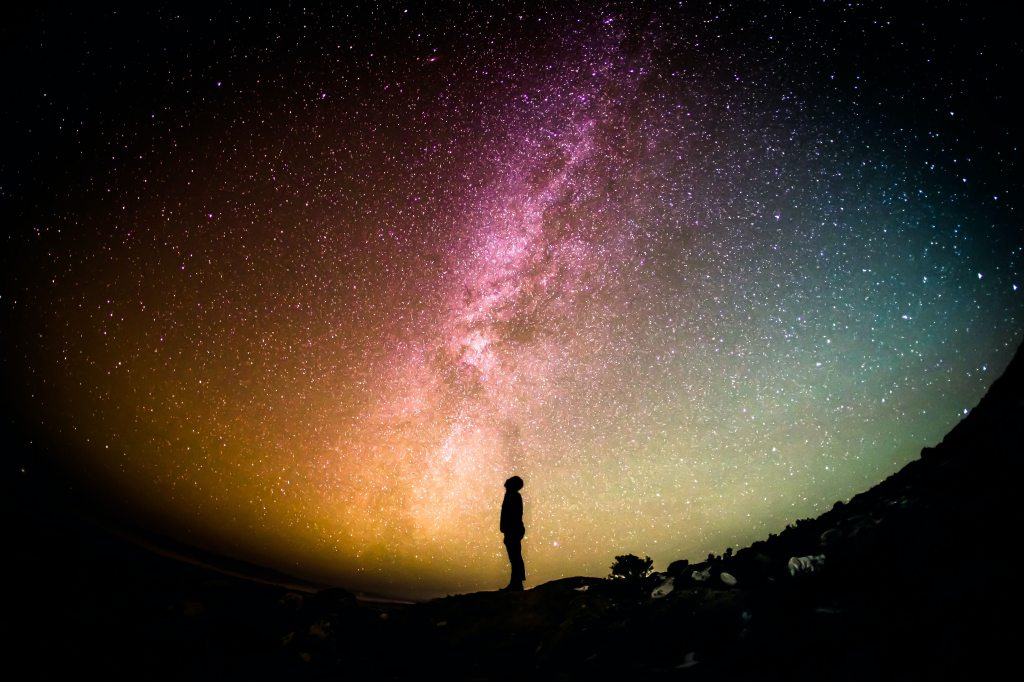
Photo by Greg Rakozy
The time of synchronicity
As the Greek root of this word shows, synchronicity refers to time (syn means meeting and chronos means time). The ancient Greeks conceived synchronicity in three distinct ways: the chronos, which corresponds to a linear flow; the aion, or the endless cycles; the kairos, that is the right moment to act.
In the Greek mythology there is the winged god Kairos. When Kairos passes by there are three possibilities:
You don’t see him;
You see him but you do nothing;
In the moment he passes by you give him your hand to grasp the chance he is offering you.
In practice, synchronicity is telling you carpe diem, namely seize the moment.
Perdi il treno e sulla banchina incontri l’amore della tua vita. Ti arrivano dei soldi proprio nel momento in cui ne avevi bisogno. E’ questa la magia delle sincronicità. Sono delle coincidenze felici che ti lasciano a volte senza parole e ti fanno intravedere un nuovo cammino.
Che cos’è la sincronicità
Il principio della sincronicità è stato messo in evidenza da Carl Gustav Jung e sviluppato da Wolfgang Pauli, uno dei padri fondatori della meccanica quantistica, premio Nobel della fisica nel 1945.
Si tratta della comparsa simultanea di due eventi indipendenti, che non sono in rapporto causa effetto, ma sono legati da un significato.
Leggi questa storia raccontata da Jung per capire di cosa si tratta.
Una giovane donna di buona educazione e classe sociale entrò nell’ufficio di Jung. Jung vide che il cambiamento psicologico per la donna sarebbe stato difficile a meno che lui non fosse stato in grado di ammorbidire il suo guscio razionalista con un po’ più di umanitá. Jung aveva bisogno della magia della coincidenza e cercava di trovarla attorno a sé. Così osservó con attenzione la giovane donna, sperando che qualcosa d’inaspettato e irrazionale venisse fuori.
Mentre lei descriveva uno scarabeo dorato – un costoso pezzo di gioielleria – che aveva sognato la notte prima, Jung sentì picchiettare sulla finestra. Quando guardò vide un luccichio verde-oro. Jung aprì la finestra e prese lo scarabeo che volteggiava nell’aria. Il coleottero, molto simile a quello d’oro, era proprio quello di cui aveva bisogno, oppure ciò di cui lei aveva bisogno.
«Ecco il tuo scarabeo», disse alla donna, mentre le porgeva il legame tra i suoi sogni e il mondo reale. Questo provocò uno choc nella donna che le sbloccò la mente e la aiutò moltissimo nella sua terapia.
Un evento sincronico va oltre la semplice coincidenza perché la presa di coscienza ha un potere trasformatore, che segna un prima e un dopo nella storia personale.
Per poter notare le sincronicità dobbiamo sviluppare attenzione e spirito d’osservazione.
Se cominciassi a notare con curiosità quello che ti accade durante la giornata, la tua quotidianità diventerebbe uno spazio gioioso di possibilità e di opportunità.
Nascosti o evidenti, questi messaggi effimeri sono così preziosi che meritano tutta la nostra attenzione. Vedrai che allora, più noti queste coincidenze significative, piú queste si moltiplicano e ti aiuteranno ad uscire dalla tua routine per farti dirigere verso qualcosa di nuovo. Cambiando prospettiva, riuscirai anche a far muovere la realtà oggettiva.
Prova a fare uno di questi giochi e vedere che sensazioni ti lasciano.
Il gioco del libro. Scrivi una domanda, poi apri un libro a caso e fermati su una pagina a caso. Lascia scorrere le tue dita ad occhi chiusi sulla pagina e quando ti fermi apri gli occhi per scoprire il testo che hai scelto casualmente. Quali sono le tue sensazioni e i primi pensieri? Scrivili e cerca i collegamenti con la tua domanda.
Anche il gioco del marciapiede può farti arrivare un messaggio inaspettato mettendoti in contatto con un simbolo o una situazione. Cammina con i sensi in massima allerta e nota tutti i dettagli. Per esempio, cogli alcuni elementi di una conversazione fra due persone che incroci, leggi una pubblicità, guarda un graffito oppure un giornale lasciato su una panchina. Sono segnali che possono aiutarti a trovare la risposta a una tua domanda.
Anche i lapsus o le disgrafie possono essere un indizio da esplorare. Per esempio, spesso mi capita di scrivere massaggio al posto di messaggio. Credo di avere bisogno di farmi fare un massaggio…
Questi suggerimenti arrivano per farti aprire le porte e non per chiuderle. Ti offrono la possibilità di vivere con entusiasmo e divertimento delle esperienze ricche di senso e di abbandonare i piani stabiliti da un ego che ti costringerebbe a seguirli.
In questo modo hai la possibilità di connetterti all’inconscio collettivo perché aderisci a delle credenze positive e non bloccanti. Più fai attenzione a queste sincronicità, più i tuoi circuiti neurologici ed emotivi sono stimolati positivamente e questo crea dei nuovi schemi comportamentali, installa delle abitudini benefiche che ti mettono in collegamento con la coscienza dell’universo.
Photo by Greg Rakozy on Unsplash
Il tempo della sincronicità
Come le radici greche di questa parola lo mostrano, le sincronicità fanno riferimento al tempo (syn riunione e chronos tempo). Gli antichi greci le concepivano secondo tre modalità distinte: il chronos, che corrisponde allo scorrimento lineare; l’aion, ovvero i cicli senza fine; il kairos, cioè il momento giusto per agire.
Nella mitologia greca esiste il dio alato Kairos. Quando Kairos ti passa vicino hai tre possibilità:
non lo vedi;
lo vedi ma non fai niente;
nel momento in cui passa gli tendi la mano per cogliere l’opportunità offerta.
In pratica, le sincronicità ti stanno dicendo: cogli l’attimo.
I’m sure you use the word stress often throughout your day.
We all feel a little stressed due to the multiple commitments we have, pending deadlines, and lack of time to dedicate to ourselves.
The common denominator of all forms of stress is a feeling of malaise, fatigue, irritability that makes us more fragile with illness and less tolerant of others and of daily problems.
Actually stress is an adaptive response that has allowed our species to survive throughout its evolution.
Hans Seyle, the first theorist of stress, conceived it as an adaptive response that the body puts into force to overcome all the situations that its alarm systems deem dangerous.
The stress reaction is indeed characterized by the secretion of hormones such as cortisol and adrenaline which make the muscles stronger and the person more reactive. In this sense, stress has a value that is not only positive but also necessary for the survival of the species.
Primitive men had to face dangers that were of a short duration. While they were hunting, for example, they might encounter an animal and had to decide whether to run away or face it (have you ever heard of the “fight or flight” response?), but once they made up their mind and acted accordingly, they had plenty of time to recover.
Photo by Crawford Jolly on Unsplash
In the contemporary age, we too have this type of reaction when facing what, on a conscious or unconscious level, we perceive as dangerous (stressor). But today’s stressors are definitely different from those our ancestors faced. Modern stressors are psychosocial and no longer physical. It’s about the work environment, social relationships, financial worries, the huge amount of commitments we have and the limited time to complete them. Above all, these stressors are not momentary but can persist for a long time and consequently we need more time to recover.
Look at these signs that may indicate that stress is becoming a threat to your health:
What can you do concretely to combat stress, when the conditions in which you find yourself do not allow you to avoid it?
Physical activity, especially aerobic, such as brisk walking, swimming and cycling, is undoubtedly one of the best remedies for stress.
Breathing control, like getting used to using the diaphragm and slowing the respiratory rate, is another useful tool against stress.
Other activities may be: yoga, tai chi and meditation. In recent years, mindfulness has become popular. Mindfulness, by increasing the level of personal awareness, carries out an anti-stress action.
Obviously, a good massage that helps you increase the level of oxytocin, a hormone capable of counteracting cortisol, is certainly effective.
As regards food supplement, magnesium is the anti-stress mineral for excellence, also because we are chronically deficient. Remember that a supplement is such because it must be complementary to a healthy diet. Therefore, remember to eat well!












 Crisbie Coach