I read this story that I want to share with you because I find it very beautiful.
An elderly Chinese woman owned two large vases, which she carried hanging from the ends of a long pole resting on her neck.
One of the two vases had a crack, while the other was intact.
Every day, the elderly woman brought home a vase and a half of water.
The intact vase was proud of itself, while the broken vase was terribly ashamed of its imperfection because it could only perform half of its task.
After a while, it finally found the courage to speak to the elderly woman, and from its end of the pole, it said, “I’m ashamed of myself because my crack makes you bring home only half of the water you collect.”
The elderly woman smiled and said, “Have you noticed that on your side of the road, there are always flowers, while there are none on the other side? This happens because, since I know you have a crack and let the water leak, I planted flower seeds only on your side of the road. So every day, when we return home, you water the flowers.”
Throughout this time, I have been able to gather flowers that have brightened up my home and my table. If you weren’t the way you are, I would never have been able to delight in their beauty and decorate my dwelling.
Here is the moral of the story
Each of us obviously has our weak side. But it’s the cracks and imperfections we have that make our life together interesting and beautiful to live.
You just need to be capable of taking each person for who they are and discovering their positive side.
A hug to all those who feel like a broken vase, and remember to enjoy the scent of the flowers on your side of the road!
The publication on Facebook or other Social Media provokes a contagious phenomenon. Both positive or negative news generate a reaction from the followers. That’s why I think that sharing little good things would bring positivity to your life.
I rarely publish negative things on Facebook, with the exception of some situations that happen in big cities, like a poor waste collection. I definitely prefer to publish positive news because I think that generally speaking the media report mainly about bad news. I am convinced that both positive and negative things happen in the world. Honestly, I think that more good things happen and that they are worth sharing. By sharing good things, you will help the world be a better place as positive energy will spread all over around you. Bad news attracts the attention of the public because of their morbidity but they only contribute to the creation of a spiral of negativity.
Social Crisis
It is true that our society has been in crisis for many years now and that politics does not offer adequate solutions to problems that are increasingly complex. There are too many homeless people, salaries are low and life is expensive. But despite this I am sure that life reserves us moments of joy that we should not hide, rather we should celebrate!
I am happy about my life overall. Of course, the environment that surrounds me is not ideal; sometimes things do not go as they should; I see injustices, I have my intolerance and suffering, but I don’t let myself be involved in this negative spiral. If I think about the life that our grandparents used to live, then there is nothing else to do than rejoice. We have food every day, running water, electricity and heating in our homes. In Maslow’s hierarchy of needs we surely passed the first two levels. What if you were a woman born in Afghanistan and had to wear the burka? Or if you were born in a country at war? Or if you were forced to pay a fortune to heal yourself?
Therefore, do not hesitate to share your moments of joy, your successes, small or big, because this will spread and create positivity all around you. Of course, not every day will be spring, but I’m sure you can always find a small good thing to share.
This does not mean that you should not try to improve yourself, but it does mean that your personal development would be easier if you looked at the glass half full instead of the glass half empty.
After having read a lot about happiness, I found out that you also would need to accept that you cannot always be happy because it will make your life easier.
What is the real meaning of being happy? Is it really necessary to be happy all the time to be successful in life?
Some researchers state that happiness means designing your own quality of life and also finding ways to strive for continuous improvement. They say that we all have a social purpose to live for, that is our mission. If you keep a journal, for instance, you would be able to evaluate the activities that make you happy and compare them with those that make you unhappy. In this way you may have a choice. You can also compare yourself with others’ activities to find out what makes them happy and get inspired. It doesn’t mean that you have to compare yourself with others: you are unique, and in some cases you don’t even know those people very well.
Moreover, there is not a single recipe to be happy. Not everyone will be happy by practicing meditation or sports, for instance. There are, however, common factors that will influence your happiness: valuable relationships, a meaningful job, work-life balance, a great partner and good health. In any case, you may find someone who is not happy in spite of the fact that they have a good job and they get along well with their partner.
Yet, there are also researchers saying that it is not important to target happiness as such, but you would need to to learn how to be unhappy, by accepting the moments of unhappiness without judgement and as part of your life.
Being always positive is not good
Some scientists see with a critical eye today’s trend on being always positive. Avoiding facing distress, sorrow, misery is not a solution. You can’t ignore being unhappy, you have to accept it for what it is. You can also share your negative feelings or emotions with others, it will help you create and strengthen your relationships. When you are worried and you know that someone will listen to you, you may feel a bit better after having shared your distress and discomfort.
Actually, those who pretend to always be happy may end up being alone, isolated and of course unhappy.
Accept what life gives you in the present moment
This sounds like a paradox but if you try to accept your unhappiness as a moment in your life that sooner or later will fade away, you will be more content.
The most important thing is to be happy with the life you live, acknowledging and accepting the ups and downs that are part of your life. As the French say, c’est la vie.
Today is the first of January and many of us have decided about their resolutions for 2023, or are about to do so. The new year brings the desire for a change, the need for renewal. We would like to spend more time with our family, to take that trip that we have been dreaming about for so long, to change our job, to enrol in a gym club, to lose weight, to stop smoking…the main goal is feeling better with ourselves and with others.
Why does it happen then that along the way we forget about our resolutions or we abandon them?
Here are some questions you should ask yourself.
Are your resolutions too ambitious, vague or simply they are too many? In this case you are putting too much pressure on yourself. If you have decided to stop smoking or to lose 10 kilos, you must ask yourself why you have started smoking and why you are always hungry. Are they ways for relieving the daily tensions?
Are you positive in comparison to the achievement of your resolutions? If you think that you will never make it, it is sure that you will never make it. Henry Ford used to say: “If you believe you can make it or if you believe you cannot make it, you will always be right”.
Are your resolutions appealing? You have decided to lose weight or to stop smoking. As such, they are great objectives. But find a bigger reason for which you want to achieve these objectives. For instance, you want to stop smoking to be able to recover breath faster when you go jogging or you want to lose weight to put on those beautiful pants that suited you very well.
Bad habits are difficult to lose, above all you need time. If you have been sticking to them for years, you have your good reasons (to protect yourself from stress, for example). You cannot change your habits in some weeks. Some time ago, studies stated that you could take up a new habit in 21 days. Now, neuroscience has found out that you need at least 60 days! Take your time then, establish a new habit with calmness, don’t stretch your body too far, your body is comfortably used to the old habit and it doesn’t feel like changing it. You must make it understand, day after day, that another way is possible and it is also healthier!
Besides, remember that the path won’t always be linear and you may find obstacles. There will be some easy moments and some difficult ones but losing a battle doesn’t mean losing the war. Accept the ups and downs: your body will learn to adapt slowly.
Choose an objective that won’t sound like an obligation, in the sense that it must represent a real choice, a thing that you want to do, not that you must do. Control your thoughts, remember what Henry Ford said. Don’t focus on what you still have to achieve, but celebrate what you have already achieved. List the small victories and congratulate yourself. Stay positive!
Think about the strength that a seed has to become grass. It must come out from the soil to be able to live and flourish. It works slowly under the soil, up to when one day it comes out and sees the light! For you it is kind of the same thing. Work slowly and one day you will see the results, because you are stronger than you think.
And now four tips:
1. set one objective at the time, but define it well, use the SMART model (specific, measurable, attainable, relevant and time bound). Even though this model has been created for organisations, it may be helpful also to individuals engaged in goal setting.
2. Adopt the strategy of small steps by dividing your objective into smaller objectives.
3. Celebrate achievements: the first kilo you have lost, the first whole day without smoking. Put some post-it all over your place with your success on it. Tell yourself “Well done!”.
4. Inform your family and friends about your goals and ask them to help you with this. Getting their support will help you in achieving the results. Look for some groups on Facebook that share your same goals, and participate in forums on the Internet. Remember that you are not alone, there are other thousands of people that may have your same goals and exchanging ideas with them can be helpful to you. You can create a blog that can become your journal (a journal on paper is also okay).
Our mind is fascinating. It has its own rhythm, unique perceptions and we are not aware of all its possibilities yet. Waves of thought run through our mind but I must say that unfortunately most of them are negative. However, you need to know that there is a way out to go around your negative inner monologue: positive affirmations.
I read about the importance of positive affirmations in one book of Louise Hay.
Affirmations are short positive sentences that motivate you, inspire you and encourage you to take action to achieve your goals. To make them work you have to repeat these phrases several times throughout the day, to make them stay etched in your unconscious mind.
Repetition can change your habits, behaviour, and point of view. As you may know, words are powerful. Regular repetition, aloud, but also within you, turns into thoughts that create your reality. Positive thoughts have the power to overcome internal negative speech. You may find it odd to say phrases like “I choose to be happy” in front of a mirror, but I assure you that these statements really help you reinforce the good vibes. Regular repetition of affirmations becomes your truth.
A statement firmly and confidently declares a positive thought and transforms it as a truth. By integrating these positive statements into your daily routine, you help your mind prioritize positivity.
According to some researchers, affirmations can help you work better. Spending a few minutes reflecting on your abilities before a stressful meeting, for example, can calm your nerves, increase your confidence, and improve your chances of success. Affirmations can also help you relieve stress.
Here are some of the benefits you can get from practising affirmations regularly:
Become happier. Affirmations allow you to recognize the things that keep you from being happy, because you focus on what you really want in life. In addition, your mood will get better.
See things in perspective. We often take the simplest things for granted. Using affirmations allows you to remind yourself that the simplest things are the most important. For example, if you are in good health, by using the statement “I am in good health” you can focus on this point and appreciate it more.
Reduce negative thoughts. Since most of our thoughts are unconscious (and negative), positive affirmations allow you to become more aware of your thought patterns and feelings, thereby reducing the risk of creating a recurring negative thought.
To get the best out of affirmation practice, you need to observe these three basic rules:
Plan repetition during specific moments throughout the day. Good times could be in the morning as soon as you get up or in the evening before going to bed. Each of us will find the best time to devote to repeating affirmations.
Use the verb in the present, because you want results now and not in the future. Furthermore, the brain only understands the present tense.
Do not use the negative form (for instance, do not say “I don’t take into account judgements from the others” but “judgements from the others are irrelevant to me”).
There are no strict rules on the frequency of repetitions. Nevertheless, according to psychotherapist Ronald Alexander of the Open Mind Training Institute, the statements can be repeated three to five times a day to reinforce the positive effect.
Do you like to write? Perfect! Writing your affirmations in a journal and reading them in front of a mirror is an effective way to make them more powerful.
Here are some affirmations you could practice if you want to try if they work for you too:·
I believe in myself and I trust my abilities.
I am the creator of my thoughts.
I am a successful person.
I choose to be happy.
An amazing family and very good friends surround me.
I am strong and courageous.
When I go to bed, everything is as it has to be and I fall asleep peacefully.
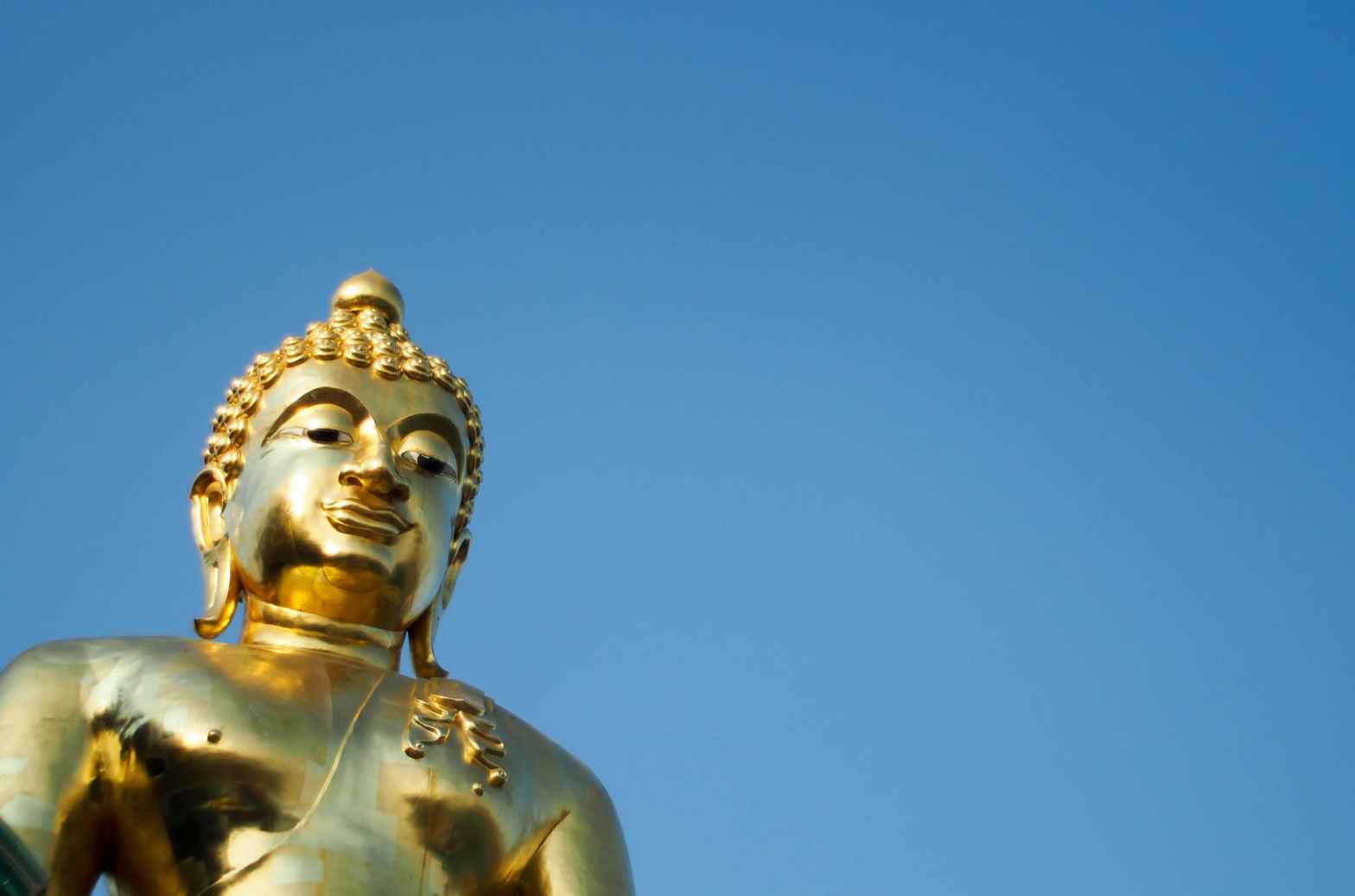
I found this beautiful story about a Buddha statue and would like you to share it with you. I do not know if it is true or not but I think it is very meaningful.
The mud Buddha statue was nearly three meters high. For generations it had been considered sacred by the locals. One day, due to the growth of the city, they decided to move it to a more appropriate place. This delicate operation was entrusted to a recognized monk, who, after careful planning, began the move. His luck was so bad that, in moving the statue, it slipped and fell, breaking into several parts.
Mortified, the monk and his collaborators decided to spend the night pondering the possible solutions. They were long and dark hours. The monk, instead of despairing, aimed to find a way out. Suddenly, observing the shattered sculpture, he noticed that the light from his candle was reflected through the cracks in the statue. He thought it was the raindrops, as it had rained in the afternoon. He approached the crack and noticed that there was something under the mud, but was not sure what it was.
He consulted with his colleagues and decided to take a risk that seemed crazy: he asked for a hammer and began to break the mud, discovering that under it, a nearly three meters high gold Buddha was hidden.
For centuries, this beautiful treasure had been covered under ordinary mud. They carried out a research and found out that the village was about to be attacked by bandits. Therefore, to protect their treasure, the inhabitants covered it with mud to make it seem common. The people were attacked and pillaged, but the bandits ignored the Buddha. Afterward, the inhabitants thought it was best to keep hiding it under the mud.
Over time, people began to think that the Golden Buddha was a legend or an invention of the old people. Finally, everyone forgot about the real treasure because they thought that something so beautiful could not be true.
However, eventually, they discovered a real treasure!
I think that it is the same for us. You can find some treasures under the surface. Your treasures may be your ability to give, to enjoy, to thank, to laugh, to forgive, to dream big, to pass over the little things, and to value what is important in yourself and in others .
Learn to see your life through the mud and you will realize that you also are a treasure surrounded by other treasures.
As I was saying before, we have not been taught to take good care of ourselves. We put often aside our well-being. How many times have your parents told you to look well after the others or do things for the others? How many times, on the other hands, have you been told that you must also take care of yourself?
The way you look after yourselves is a kind of extension of what you have learned from your parents, teachers or caregivers.
For a very young person this may seem exaggerated, as some basic principles of self-esteem are taught in schools today. Some parents also try to instil some self-care virtues in their children.
However, for an adult or elderly person, taking care of themselves well and being truly respectful of themselves is not always something they have consciously internalized. In the past, it was not so easy to find someone who could help you cultivate a certain self-love without it being considered selfish.
In fact, this is precisely the basis: self-love, not to be confused with narcissism or egocentrism. To better understand this concept, we can first imagine what we do when we really love someone: we seek their happiness, we help them, we try to make them feel good, and we accept them as they are, with all their imperfections and qualities. Actually, looking well after yourself means really accepting yourself for who you are.
Becoming kind towards yourself, means understand yourself, especially when you face failures and mistakes.
Photo by Klimkin on Pixabay
That attitude can be a great ally. You can challenge yourselves in a healthy way, taking into account your possibilities, your desires, and not the desires that others have for you.
The use of language is very important to achieve the goal of taking good care of yourself. It is common, and to some extent normal, that on some occasions you speak “badly” to yourself, you do it unconsciously. You cannot talk to yourself always in a loving way, as you could enter into toxic positivity (when a positive attitude is used to mask negative emotions, namely pretending that all is well when it is not).
However, you must not use words that hurt yourself. Nobody insults those who truly love, right? Talking to yourself and thinking badly about some personal aspects (physical or mental), and constantly reiterating it, can in the end make you really believe it.
Taking care of yourself is essential. This implies developing a healthier and more suitable lifestyle. Sleeping and resting enough hours, for example, as well as eating well based on our weight, age and lifestyle, not abusing alcohol or tobacco, are all ways to take care of yourself. Taking time to relax, reconnect with what you really like to do, keep your hobbies, follow your passions and interact with people who bring you something positive in your life means being respectful of yourself.
The society we live in often leads us to reverse priorities and put work first. This can negatively affects our quality of life and physical, mental and emotional health.
According to researches carried out in France, physical suffering related to work affects 3.1% of women and 1.4% of men, but according to some experts, the figures are higher. The international classification of diseases identifies burn-out as a work-related phenomenon but in reality work is not the only cause.
With the cost of living constantly rising, we are likely to work longer hours to earn a salary that allows us to provide for our own needs and those of our family. Because of this, many elements of our private life are put aside.
We spend many hours working, reducing the time to eat, to rest, to be with the family, and we do not realize how much this can harm us.
While most of us cannot afford to leave their job, a balance must be found between work and private life to prevent stress from building up in a worrying way.
Photo by Christin Hume on Unsplash
In this period of forced tele-working, it is even more difficult to put boundaries between work and private life. For this reason, many governments have been drafting directives that establish the right to “disconnect”. We need to have the time to do sports, to walk, to take care of our dear ones, to follow our passions or simply to rest.
More and more people suffer from stress, feel exhausted, have problems with nutrition, addictions, or relationship difficulties, and all that because of the long working days, which do not leave us the time to do activities for our well-being.
If you feel you are in one of those situations, know that no salary is worth your health, no job is worth the wear and tear that comes from working days that annihilate your energy and happiness.
If you have no other alternatives to the work you are currently doing, find something positive to balance your life, because otherwise, there may come a time when you will start making mistakes at work and your overall performance will suffer. Start looking for another job but put your health in the first place, because if you get ill it may take a long time to recover.
Your job is an important part of your life, but it is not your life. There is much more: family,health, and friends. Do not allow work to take up all the space in your mind and body, taking the joy away from you.
Remember always taking care of yourself first, because this is the only way you can live a better life.
Karma is one of the most known concepts of Buddhism. At the same time, it is also one of the least understood. You may hear speaking about having a good or a bad karma without really knowing what it is about.
What is karma then?
Karma is a Sanskrit word meaning “act” or “action”. According to Buddhism, karma is a cause-and-effect law: to each action corresponds a reaction. For Buddhists karma is part of the natural forces of the universe, such as the gravity force, for instance. According to the principle of karma, all our actions, thoughts and intentions create energy: they are causes that have consequences. If we let go positive energy, we will receive positive energy. At the same way, if you send negative energy to the world, you may get problems and difficulties. Karma is simply an echo of what we do, say and think.
This does not mean that karma takes revenge! Karma does not take revenge when we emit negative waves. However, this is the general Western understanding of karma. We think that it is a kind of punishment from the universe for our bad deeds of the past. But karma does not work that way, it is neither a revenge nor a justice. Karma is reflected energy.
How to live according to karma.
To create a good karma, you have to send positive vibrations to the world. This does not necessarily mean that you have to donate all you savings to an NGO or quit your job to work as a volunteer. It is the small gesture of daily generosity that count, such us giving up your seat on the bus, inviting that friend you have not seen for a while to drink something, or helping a colleague in difficulty.
Do not forget to express gratitude when others take care of you. What matters is to act selflessly, not to expect anything in return. Simply appreciate doing a good deed without a hidden agenda, even if you just keep the door open for your neighbour.
If you put a crab in a bucket, it can run away, but if you put together a group of crabs in a bucket, none of them can escape, because as soon as one will start climbing, another will reach it, grab it and pull it down!
That’s why you should never hang out with crabs inside of the same bucket. If you want to change your life, change your relationships!
Some people are like those crabs. They push you down, while others pull you up.
That’s why changing your relationships is so important for you, if you want to be successful.
Try to spend more time with successful people caring for you, those who give you excellent advice are those who bring you up. Don’t go with crabs, those that try to pull you down.
After spending more time with successful people, you will learn a lot and you will become like them. They are contagious!









 Crisbie Coach