This story tells us why we should appreciate the differences to build up collective intelligence.
Alone we go faster, together we go further – African proverb
An Indian story tells us about the discovery of an elephant by six blind people.
Each of them touching only a part of the elephant described it differently depending on where they had touched the animal. So, one compared it to a wall, another said a spear, another a snake, or a tree, a fan, or a rope.
They began to argue about what they had felt by touching the elephant. The discussion became very animated because each of them wanted to be right.
A wise man passed by and heard them arguing. Then, he approached them and with a smile said: “The elephant has all the traits that you have described, because you have touched only one part of the animal. That’s why you describe it differently.”
This story explains well that it is quite inappropriate to be sure that we are right because reality always exceeds our personal visions, our context based on a unique path and limiting beliefs.
Differences when they become obstacles take away the opportunity to broaden our consciousness and enrich collective intelligence, where 1 + 1 equals 3.
Therefore, considering an ally the one who thinks differently rather than an enemy or a rival, would not lead us to add up our different approaches but we will reach new solutions, which would exceed the individual contribution of each of us.
Once again, common sense invites us to be tolerant rather than judgmental, because to judge means to separate but, as the African proverb says, “Alone we go faster, together we go further”.
He did so because the British government had chemically castrated him, humiliated him and tried him because he was gay.
For this reason there is a bitten apple on the Apple logo, in honor of Alan Turing.
Alan Turing invented computer science and using his first drawings deciphered the Enigma code – the encrypted machine that the Nazis and the German army used to communicate secret commands with each other during World War II.
Thanks to this, he saved millions of human lives and with him began the modern era of computer science.
Alan Turing’s story should remind us that Pride is not just about dancing on floats and waving a rainbow flag.
Above all, it must remind us that everyone has the right to be happy, to love everyone who wants to love and to recognize the remarkable contribution that we all can make in a society free from fear or prejudice.
It is the end of winter and spring appears timidly showing us the first blossoms, longer days and birds that build nests.
Spring marks the awakening of nature and therefore also our awakening, not only physical but also spiritual.
There is a Sanskrit word that defines spiritual awakening, but which actually means “liberation”. The word is Moksha.
According to the Indian tradition, the discovery of one’s Self is associated with that of freedom.
But why? What kind of freedom are we talking about?
First of all, let us remember that waking up our true nature means becoming aware that there is a much wider presence within ourselves than the individual we normally identify with. The Self is called Atman in Indian philosophy.
The first freedom that we should discover is to abandon identification with the body. In fact, by discovering our Self, we stop living as prisoners inside our body. Suddenly our presence, which was previously closed within the perimeter of our skin, becomes immense and limitless. We join the world. We are no longer inside our body, but it is our body that is inside us.
The second freedom is the discovery that we are not dependent on our thoughts. The Self is not a thought, but it is consciousness, the awakened space in which our thoughts appear and disappear. Liberation from thought is like liberation from a corvee, from a hellish cycle of recurring thoughts, and it gives us silence.
The third freedom consists in the discovery that our Self is free from our past, from what has happened to us of both positive and negative. Our past remains, of course, and constitutes our history, but the Self lives only in the present moment, so it is always new, original, fresh. It allows us to regenerate the source of our presence every moment.
The fourth freedom is that from the judgment of others, which too often is very heavy. Others see us, judge us and this makes us lose some of our freedom. But others cannot see our true Self, they cannot see who we really are. They only see our appearance, our body, but they cannot see our true nature. Thanks to awakening we are able to free ourselves from the gaze of others and finally to be free.
What is the ego? Is it really negative? How to keep it under control?Is the ego a friend?
The word ego comes from the Latin and means “I”. It is difficult to define it because it is not visible and it manifests mainly in a negative way. It is easier to recognize the ego in others than in oneself.
Sometimes, the ego is represented with animals. The octopus, the bloodsucker, any parasite, the wolf or the tiger. Or it is also represented with objects. Mask, dress, glasses, onion, egg or even serious illnesses.
It is a mystery and a paradox at the same time. The ego is us but not really us. It is a false self, or a pseudo self. It is not the personality but a part of the personality. It is not our true consciousness, but an altered, partial and non-objective consciousness. It does not represent a real need, but it wants to make us look perfect in a certain way, it wants to control everything and always be right. It is not real, but an illusion, an empty shell, which is based on fear, separation, loneliness and opposition. The ego can be a defensive or an aggressive reaction. In reality, the ego tries to protect us from showing our vulnerabilities.
Is the ego negative?
For Westerners, the ego is a necessary evil with which we must live, it is not so serious, indeed sometimes it can be useful or even positive. In fact, Western civilization since 1623 is based on the ego thanks to Descartes.
On the contrary, for spiritual masters, most of them Orientals, the ego has nothing positive, since it is the opposite of love, it represents our dark part, our Mr. Hyde, our shadow zone.
The ego is a false friend that makes us lack authenticity, honesty, and humanity. This is why certain traits of our character might be selfishness, self-centredness, narcissism, individualism, greed, possessiveness, materialism, avarice, susceptibility, and even paranoia. The ego is responsible for almost all of our negative emotions, especially hatred. It pushes us to defend ourselves, to justify ourselves, to rationalize, to deny the evidence, and generates childish behaviours. Escape, rejection, negative or destructive communication (like haters). It can also be responsible for toxic relationships, manipulation, harassment, and violence in a broad sense.
Why would we keep the ego under control?
On an individual level, keeping the ego under control would mean being happier, having better physical and mental health, more self-confidence, connecting better with others, living in harmony, having happier relationships, more energy, and being even more efficient.
On a social level, keeping it under control would help society overcome racism, sexism, nationalism, domination, oppression, exploitation, delinquency and even war! It would allow us to live better together, to develop a sense of brotherhood, equality, cohesion, solidarity, understanding and peace.
How to keep the ego under control?
It is impossible to eliminate the ego, because it is part of our personality. What we can do is trying to control it.
At the social level there are institutions such as the family and school that are delegated to this role. Other institutions, such as the police and justice, try to correct it.
We can try to transform the ego into our ally with meditation techniques, practising yoga, or using psychotherapeutic techniques that can help us to be more attentive, conscious, and to become more collaborative. We will be able to learn to listen, to help, to forgive, to let go, to create, to laugh and make people laugh, and of course to love.
I would like to conclude with a short story, The Story of the Two Wolves.
“One evening, an old Indian grandfather tells his grandson the story of the two wolves.
In each of us coexist two wolves, constantly fighting. One is bad, angry, jealous, sad, greedy, arrogant, liar, feels superior to the other wolf.
The other wolf is kind, empathetic, generous, sincere, compassionate, cheerful, peaceful, serene, hopeful, and humble.
The grandson asks his grandfather: “Who wins between the two wolves?”
Grandpa simply answers, “The one you feed will be the winner.”
Over the last few years, a very old practice has become the subject of scientific studies: yoga. Positive effects on the brain have begun to be measured, such as anti-stress and anti-depressant effects.
The studies began thanks to the spectacular spread of yoga. Millions of people practice yoga regularly. Positions (asanas) such as the warrior or the cobra are increasingly known among different people and age group. The reasons are mainly that persons want to learn how to relax, how to get rid of several kinds of pain (back, neck, shoulders, etc.) manage stress, and maintain good physical shape.
Traditional yoga (from the Sanskrit “yuga” which means “union”) comes from India and is a discipline more than five thousand years old. An important source of this spiritual school, which should guide us towards the divine, is a writing by Patañjali: Yoga Sutra, which contains the essential foundations of the discipline.
According to this essay, the purpose of yoga is to attain a higher form of self-knowledge, which can be achieved with inner contemplation. In addition to specific physical exercises, and breathing techniques, traditional yoga also includes meditation, a vegetarian diet and an entire philosophy of life. The modern and western form of yoga omits many of these elements. The development of strength and plasticity, meditation and breathing exercises play the most important role today.
At the beginning of the twentieth century, a small group of Indian yoga teachers began to spread the teachings of yoga in the Western world. After the explosion of fitness in the 1980s, which focused above all on the cult of the body, the spiritual part has been lost a little. Therefore, in the Western world mainly hatha yogabegan to spread.
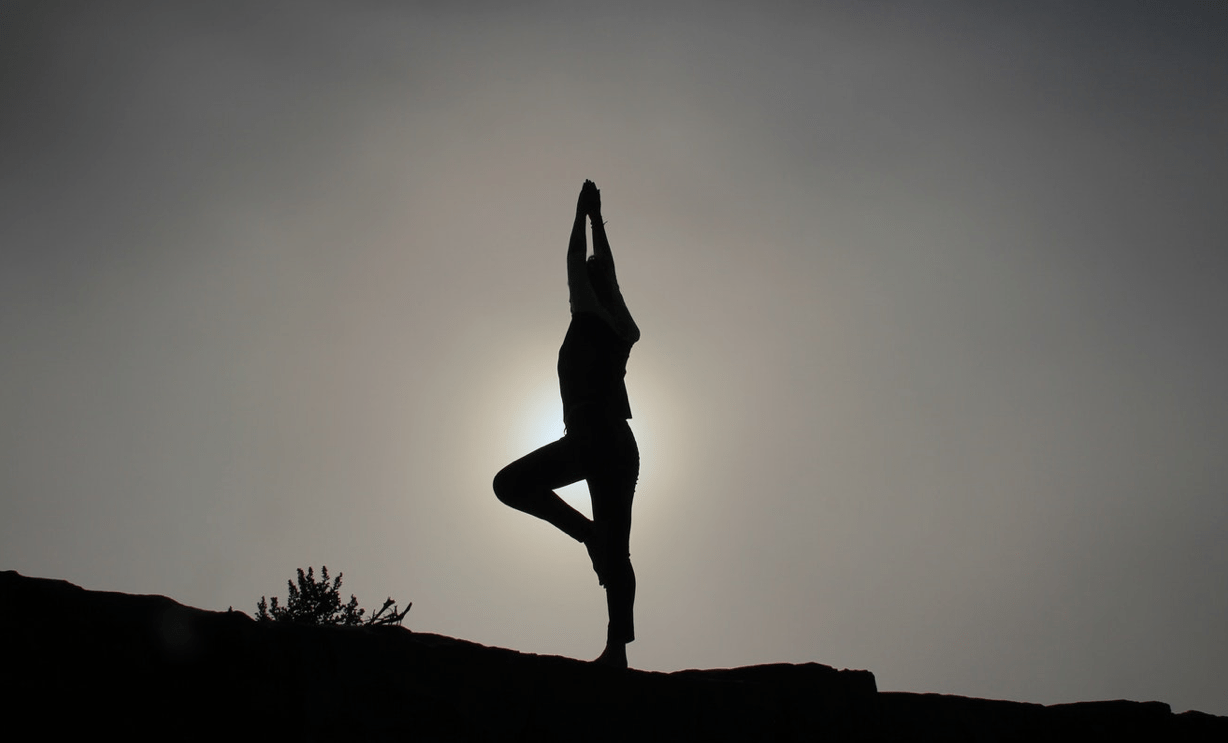
Photo by Mor Shani on Unsplash
The effects of hatha yoga on health are: improving body consciousness and coordination, strengthening muscles and enhancing blood circulation. Moreover, yoga is also beneficial to stress management.
From experience, I can say that after a yoga session I feel relaxed and rested. It takes longer to reach a similar state with meditation, while hatha yoga produces effects immediately, probably thanks to the more marked physical component. It is actually proved that physical exercise is good for your spirit. Perhaps, this is why yoga is a fast-acting cure-all, as it associates physical exercise with meditative practice.
In fact, by associating postures (asanas) with breathing (pranayama), we act on the body by relaxing the muscles, and on the spirit because the sympathetic nervous system (the nervous system that is stimulated when we rest or sleep) is activated.
Yoga allows you to find calm despite the limits imposed by everyday life. With regular practice, even 5 minutes a day is enough, you will sleep better, your self-confidence will increase, as well as your ability to make decisions and manage stress.







 Crisbie Coach