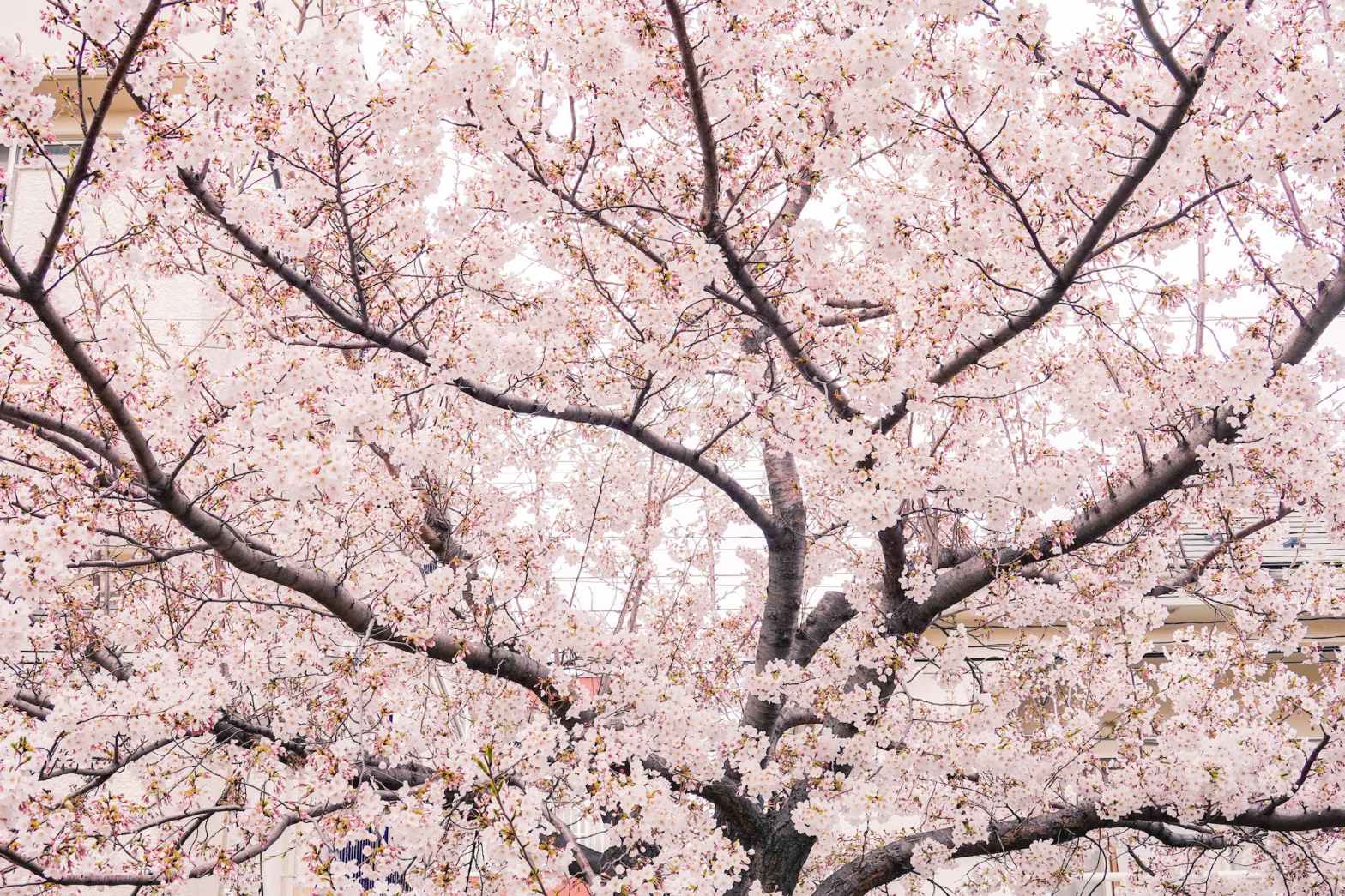
Hanami, a Japanese tradition also known as cherry blossom contemplation

In the shade of cherry blossoms, there are no more strangers.

Kobayashi Issa, Poet

Have you ever heard of the beautifully simple Japanese tradition of Hanami, also known as “flower contemplation”, better known as “cherry blossom contemplation”? It is an ancient practice of contemplating the flowers.

Life is beautiful yet fleeting. This is the feeling behind the Japanese celebration of Hanami. Every spring, friends and families gather to organize picnics and parties under the beautiful cherry blossoms. Otherwise known as Sakura, the flowers appear for a very short period between March and May, embellishing the Japanese landscape with their delicately fragrant presence.

Sakura bloom for only two weeks before the wind spreads them in nature, so the flowers symbolize the beauty and ephemerality of life. As we admire these beautiful flowers, we remind ourselves that every moment is a gift and should be celebrated as such. In this way, we learn to let our lives flourish and to appreciate every moment of joy, love and wonder that the wind brings us.

“Sa”, which means “god” (神), refers to the god of the rice fields. “Kura” represents the stand used to honor a god with offerings of food and saké.

THE HISTORY OF SAKURA

The Hanami tradition is centuries old, with references dating back between 710 and 794, and it is inspired by the Chinese custom of admiring plum blossoms. Sakura were worshipped as gods in Japan, and when the cherry blossoms bloomed, it was a sign that the god had come down from the mountain and it was time to plant rice. Emperor Saga (Heian period from 794 to 1185) was the first to throw a real party on that occasion – with food, drink, music, and poems – after having admired a cherry tree at Jishu Shrine located in Kiyomizu Temple.

HANAMI IN MODERN TIMES

This activity is so popular – and has been for so long – that the Japan Meteorological Agency is even involved in forecasting tree blooms. Cherry blossom contemplation is one of the best experiences in Japan, but it can also be practiced in many other countries. There are famous cherry blossom parks in the United States, Canada, South Korea, Brazil, Europe, Taiwan and China.

ABOUT CHERRY BLOSSOMS

  • There are nine types of cherry trees in Japan and more than 100 varieties according to the Japan Cherry Blossom Association.
  • In addition, there are 200 other cultivated varieties.
  • Their colors range from white to dark pink, and the size and number of petals can also vary.
  • Some trees can reach up to 20 meters tall.
  • A tree can also be a national monument. The Miharu Takizakura in Miharu City is believed to be more than a thousand years old and 13.5 meters high and about 25 meters wide.

Do you like this flowers’ contemplation tradition?

Do You Know Why Storks Are Said to Bring Children?

Late February, early March, in Europe, storks are back on the chimneys! This year again, they will bring beautiful babies into homes…

Finally, this is what children are told, because no one believes in this cute legend. But by the way, where does it come from?

Weddings are often held in early summer, in June-July. And in earlier times, almost elsewhere, children were often conceived immediately after the wedding, especially because there was no effective means of contraception. After 9 months of pregnancy, a peak of births happened around March, precisely when the storks returned from their winter migration!

That’s where this little story comes from, the observable link between births and the return of storks. It is a correlation, namely a statistical relationship between two phenomena. But that doesn’t mean one is caused by the other. That’s causality, and we must not confuse correlation and causality as the legend does!

In economics, for example, looking at a graph, one might think that the more mobile phones a country is equipped with, the less infant mortality there is. The two elements are correlated, that’s for sure, but the real cause of the link lies elsewhere: the country concerned is rich enough to have good maternity wards and a population that can afford mobile phones.

Between storks and births, it’s the same thing. Causality is simply the calendar, which makes the reproductive habits of humans coincide with the migration of storks. This cute legend thus originates from an error of reasoning of which we are all victims and that we call the stork effect!

Did you know this little story about storks?

Why By Walking You Will Lose More Weight Than By Running

Regular physical activity is essential for a person’s well-being. It helps with relaxation, it fights stress, chases away fatigue and it is even effective with light depression. Many people opt for cardio training to burn fat and lose weight. However, these exercises do not aim to gain muscle mass but only to increase endurance. Walking is the real cure-all activity.

You may know that cardiovascular exercises can influence the functioning of the thyroid. This gland produces a hormone called T4 which, in combination with iodine, turns into the hormone T3. The latter stimulates the body’s metabolism.

Unfortunately, during the production of cortisol while you are running, the thyroid gland does not produce the hormone T4. Therefore, it disrupts the process of metabolism, weakens the body and reduces the ability to burn fat. Because of this, excessive cardiovascular exercise can reduce your muscle mass and metabolism and, as a consequence, lead to weight gain instead of weight loss.

When running, the body burns calories and muscle mass. Therefore, you don’t not get rid of fat but you produce cortisol, which gives a feeling of hunger because the body feels the need to recover the calories burned. Overweight people should avoid running as it could damage their knees and joints.

Walking doesn’t have the same effect as running when it comes to burning calories. Actually, you burn much less calories. However, this activity is much more beneficial because it produces cortisol in small amounts. Therefore, the feeling of hunger won’t take over as much as if you were running.

The physical activity of walking is well known for its benefits because you can get a lot of muscles to work (thighs, calves, buttocks, back, abdominal belt) and by that you may refine your silhouette. It draws on fat and muscle reserves gently. To have satisfactory results, you should walk at least 30 minutes a day. It is preferable to walk in places without traffic and not too polluted, such as beaches, parks or the forests.

This exercise is also recommended for people who suffer from heart disease because it tones the heart muscle. It is also recommended for diabetics and people suffering from osteoporosis. Moreover, by walking 30 minutes, you will burn about 125 calories. I know, it’s not a lot but day after day you will see good results.

As of today, will you start walking more?

Human beings have only one great desire: to love and to be loved

It is clear to all that the world in which we live is not perfect, and that indeed there is still a long way to go to improve. Humanity has made incredible technological advances but many of us still live in fear and sorrow. But people have a great common desire: to love and be loved.

The world is plagued by war, diseases, famine, natural catastrophes, corruption, racism, inequality, and mankind has learned little from the thousands of years of civilization of which we are the heirs. We really live in difficult times. But the human being has a resource of inestimable value, love.

To achieve this, you should begin to celebrate life, its magnificent diversity, and make kindness and compassion your priorities. We are all very different, but the human heart needs to express itself by loving and being loved.

I hope to inspire you to offer your contribution to building a better world by opening your heart. Speak and listen to people with empathy, make a difference and never take anything for granted.

Opening your heart to others is not only about giving a precious gift, but it’s also about creating a bond, offering a positive experience, and building a bridge between you and a different world.

So, if you only have one thing to offer, offer an unforgettable experience to leave an unforgettable memory. Or offer forgiveness, or time and attention. And above all, be kind and compassionate.

Let me have your comments!

Why Mango is Known as the Fruit of Wisdom. A Story.

The mango is known as the symbol of wisdom. A Vedic story tells us why mango became the fruit of wisdom.  

Here’s the story.

The protagonist is Ganesha, typically depicted with an elephant’s head with a single tusk, pronounced belly and four arms. In this case Ganesha is in his guise as a child (Bala Ganapathi)  and in his four hands he holds: a sugar cane, a sweet, a branch and a mango, that is at the center of the story.

That day little Ganesha was at home with his brother Kartikeya, a handsome young man who rides a wonderful Indian peacock, and his parents, his father Shiva and mother Parvati, when the traveler Narada came to visit the family.

Narada was a wise traveler, often being a bit meddlesome and sometimes provoking conflicts between the gods just to have fun. Seeing him coming, Shiva and Parvati immediately felt the air of trouble, but the duty of welcome required them to open their home.

“Thank you for welcoming me! In return I will offer you this beautiful fruit,” said Narada, pulling a wonderful mango out of his pocket  and offering it to Shiva. “Thank you wise Narada,” replied Shiva, “but let me give it to the woman I love, Parvati.” Shiva thus handed the fruit to his wife, who, however, seeing that her two sons seemed very intrigued by that beautiful fruit, said, “Thank you, but this gift would make me much happier if my children receive it.”

She then took the fruit and was about to cut it into equal parts, when Narada stopped her. “This fruit cannot be divided! It must be eaten by one person only.” Shiva and Parvati understood Narada’s trick, but both their sons wanted the fruit at that point.

“Why don’t we make a race,” Narada suggested, “and the winner will get the fruit.” Shiva and Parvati, sighing, accepted the proposal.

The race

“The race will be like that. The first of the two children who will run 3 times around the whole world, will win the precious mango”. Upon hearing these words of Narada, little Ganesha saw himself doomed. How could he, with his small legs, compete with his brother Kartikeya, so agile, slender and able to ride that very fast peacock? 

But it was decided so, and Narada gave the go-ahead. Kartikeya set off as fast as the wind to quickly make 3 rounds around the world and went back home. 

But once there, he found his brother Ganesha holding the mango. Astonished, he exclaimed “How could Ganesha win the fruit?” You see Kartikeya,” his mother Parvati replied, “while you were running fast around the world, Ganesha made three little turns around me and your father Shiva, because we are his whole world.”

It is from this wise victory of Ganesha that the mango became known as the Fruit of Wisdom.

What do you think of this story?

Why Accepting That You Cannot Always Be Happy Makes Your Life Easier

After having read a lot about happiness, I found out that you also would need to accept that you cannot always be happy because it will make your life easier.

What is the real meaning of being happy? Is it really necessary to be happy all the time to be successful in life?

Some researchers state that happiness means designing your own quality of life and also finding ways to strive for continuous improvement. They say that we all have a social purpose to live for, that is our mission. If you keep a journal, for instance, you would be able to evaluate the activities that make you happy and compare them with those that make you unhappy. In this way you may have a choice. You can also compare yourself with others’ activities to find out what makes them happy and get inspired. It doesn’t mean that you have to compare yourself with others: you are unique, and  in some cases you don’t even know those people very well.

Moreover, there is not a single recipe to be happy. Not everyone will be happy by practicing meditation or sports, for instance. There are, however, common factors that will influence your happiness:  valuable relationships, a meaningful job,  work-life balance, a great partner and good health. In any case, you may find someone who is not happy in spite of the fact that they have a good job and they get along well with their partner.

Yet, there are also researchers saying that it is not important to target happiness as such, but you would need to to learn how to be unhappy, by accepting the moments of unhappiness without judgement and as part of your life.

Being always positive is not good

Some scientists see with a critical eye today’s trend on being always positive. Avoiding facing distress, sorrow, misery is not a solution. You can’t ignore being unhappy, you have to accept it for what it is. You can also share your negative feelings or emotions with others, it will help you create and strengthen your relationships. When you are worried and you know that someone will listen to you, you may feel a bit better after having shared your distress and discomfort.

Actually, those who pretend to always be happy may end up being alone, isolated and of course unhappy.

Accept what life gives you in the present moment

This sounds like a paradox but if you try to accept your unhappiness as a moment in your life that sooner or later will fade away, you will be more content.

The most important thing is to be happy with the life you live, acknowledging and accepting the ups and downs that are part of your life. As the French say, c’est la vie.

Why Unplugging Your Mind Is Important to Find Yourself

When e-mails, text messages, conference calls, Webex, Whatspp, FB, Instagram, Tweeter, Google and anything else from your partner to your boss invade your lives, it becomes necessary for your survival to stop for a while and be silent. That’s why unplugging your mind is crucial.

Our always connected minds take us away from the best of ourselves and our creative potential.

Referring constantly to what one or the other has said, we forget to connect to our essential being, which is unique and precious.

We have become individuals driven by technological change that moved away from ourselves, from our awareness of being human, from the first component of Emotional Intelligence (EI). EI is recognized today as a condition of success in a Volatile, Uncertain, Complex and Ambiguous (VUCA) world, as it is the one we live in today.

Refocusing, looking inside, listening to silence and our inner voice. In the depths of ourselves we find an enormous amount of resources and our most authentic creativity: it is our treasure, a unique, rich and colorful, magical place where everything is open and possible.

In this space, we can find synchronicity, messages and insights that will enable us to make the right decisions for our lives. Real relationships can arise, authentic relationships between sincere people who are now masked by the ego that continues to rule us.

What to do then?

Give yourself moments of silence! Be for a while without your mobile phone. Go out for a walk without it, walk with no direction in nature and feel, look, listen, use all your senses to the maximum.

Be present in this unique moment and let yourself be pervaded by the harmony that surrounds you.

Practice your favorite hobby, and if you do not have it, think about finding one. Quietly cooking at home, knitting, painting, drawing, gardening and all the other activities that you may be passionate about.

Stop for a moment and stop moving from one activity to another, from one piece of information to another. Your brain can not take it anymore, it also needs a rest. Give yourself time to deepen the reasons for your choices and discover the reason for your being, your purpose.

People feel lost. Most probably they are really lost: they have disconnected from themselves to live in connection with the social networks.

Therefore, unplugging your mind is very important for your wellbeing. Learn to find some space for yourself and your deeper needs. And live your life fully. You deserve it!

This Christmas

This Christmas I didn’t go home to Italy. This Christmas I am in Cuba.

Many have asked me why Cuba.

For many years I wanted to visit Cuba and finally I decided to book the flight, organize a small tour with a local agency and then finish the holiday in a hotel on a beach, that looks like the photo you see above.

I have been travelling alone with my son, my husband did not feel like coming with us. It’s a pity, this makes me a little sad, because Christmas is meant to be with the family.

But this Christmas is different. After two years of Covid, now there is war in Europe, we must save on energy, our homes and offices are all rather cold.

So, I said to myself:

  1. Carpe diem. Life is short, sometimes it is also difficult, my son will be finishing his master, I received a promotion at work, this year is the right time that we will go to Cuba.
  2. Considering the temperatures there are here in Brussels (but in Bologna it would not be better), I decide to go to get some sun on a beautiful Caribbean island rich in history, and an outpost of communism in the American continent.

That Cuba is the outpost of communism in America has not benefited them much nor does it continue to benefit them. In fact, the island has been under an embargo since the sixties precisely because of this, because they are communists. Life on the island is difficult, many things are missing. My guide told me that what for us is normal here for them is a luxury. Unfortunately, medicines are also not easily found. So, this Christmas, instead of making the usual donation to an association that wants to protect human rights or the environment, I decided to show my solidarity with the Cuban people by going to visit their island.

Wherever you are right now, I wish you a Merry Christmas and a wonderful New Year

And remember: carpe diem!

Windows

Windows are thresholds for the human mind.

Windows are thresholds for the human mind. Looking out the window, leaving your gaze suspended beyond a glass pane is not synonymous with wasting your time.  

Sometimes, the person looking beyond this threshold doesn’t want to see the outside world. They simply want to cross their reflection to navigate through the waves of introspection and reach inner worlds in search of new possibilities. In reality, there are few mental exercises that can be more useful than this one.

Windows are often indispensable resources for any dreamer. And also for that person who needs to rest after a stressful day and leans their head against the icy glass of a subway window. It is at this moment that the gaze relaxes and the imagination begins. At this time, we start to daydream and our brain finally finds relief, freedom, and well-being.

Windows allow daydreaming

Expert psychologists in the world of creativity like Scott Barry Kaufman and Jerome L. Singer, explain in one of their studies that today daydreaming is almost considered a stigma. Whoever chooses to look out the window for half an hour instead of continuing to work on their computer is nothing but lazy.

In addition, in another study by these psychologists, they showed that 80% of business leaders believe that creativity is enhanced by work and continuous activity. Thus, the person who, at some point, chooses to go for coffee in front of a window is someone who cannot stand the pressure, someone who may also be unproductive.

Today, we continue to associate action with productivity and passivity with laziness. We shall change these old and rusty ideas. Daydreaming is the art of going in search of the wonders hidden in our brain. It means training our mind to develop a little more introspection, curiosity, and imagination.

As Art, one of the authors of Wise and Shine, would say: Dare to dream.

Are you a daydreamer?

Do You Often Forget Things?

Do you often forget things, from the most trivial trifle to the most important thing you have in mind?

Don’t worry, as one study has found out that:

“The point of memory is not being able to remember who won the Stanley Cup in 1972 but to make you an intelligent person who can make decisions”

While shopping, you may forget one of the most important items you were supposed to buy, or in the middle of a conversation with friends, it’s impossible for you to remember the title or the name of the author of a book you were recommending.

In short, it feels like starting Alzheimer’s because you notice that you have difficulties remembering (almost) everything.

But don’t worry, because a study by two researchers at the University of Toronto (Canada) reveals how important it is to forget.

Paul Frankland and Blake Richards, researchers at the University of Toronto conducted a study that found out that people who are more likely to forget are also the smartest!

“It is of utmost importance that the brain is able to select the information it acquires and eliminates irrelevant details, thus focusing on a more general view to ensure that decisions are made in the most correct way.”

These are the words of Blake Richards denying the belief that those who can remember more things are also the smartest, and confirming almost the opposite. The elimination of unimportant information allows us to increase our analytical abilities, focusing our attention on the fundamental things and avoiding unnecessary work of our brain.

The researchers developed this study after several years of research on memory loss and brain activity, including both humans and animals.

The conclusion is that:

“If you forget occasional details,” Richards says, “it may mean your memory is healthy and doing exactly what it should be doing”.

Are you someone who often forgets things?

You can find more on brain here.