How to Improve the Quality of Your Life with Relaxation Techniques

As you may know relaxation techniques are simple practices you can do to help yourself calm down, cope with stressful situations, and relieve stress. The warning signs are out there: headaches, stomach knots, and racing thoughts. They are all signalling you to take action. The good news is that you can. The resources are here. They can also help you fall asleep, and go to sleep (or back to sleep) faster. 

Try out the different tips and techniques listed here and see what works best for you.

1. One Hour to Let Go

This technique allows you to finish your daily tasks and help you get ready for sleep an hour before bedtime. This exercise is done in three 20-minute sessions.

  • In the first 20 minutes, take care of any simple tasks, for instance preparing the dishwasher or feeding your cat.
  • In the second 20 minutes, do some relaxing activities like talking with family members, doing an additional relaxation technique, or thanking for three things that have happened in your day. Avoid scrolling on your phone though, as the blue light on your screen can inhibit your natural melatonin production and make it harder for you to fall asleep.
  • In the last 20 minutes, take care of your personal hygiene. Take a warm bath or shower.

Creating consistent and healthy rituals is really a good way to getting a good night’s sleep each night.

2. Guided Visualisation

Guided Visualisation uses your imagination to engage your senses. This simple exercise can be done on your own, or with the help of a therapist or a guided imagery practitioner. Here are some questions you can ask yourself:

  • What can you see? Look close and far, colours, shapes, and light.
  • What can you hear? Hear as many sounds as you can and keep looking for new ones, don’t focus on anyone for too long.
  • What can you taste? This is less fun as you are not eating, but try to imagine yourself eating something you love.
  • What can you smell? Focus on the smells around you – what are they and how many can you find?
  • What can you feel? Send your attention to the parts of your body that have contact with something, like the floor or a chair or table.

Through this technique, you can connect your conscious mind to your unconscious mind and help direct your body and brain towards a desired goal response. Guided imagery helps you relieve stress, reduce feelings of anxiety, and encourage healthy sleep.

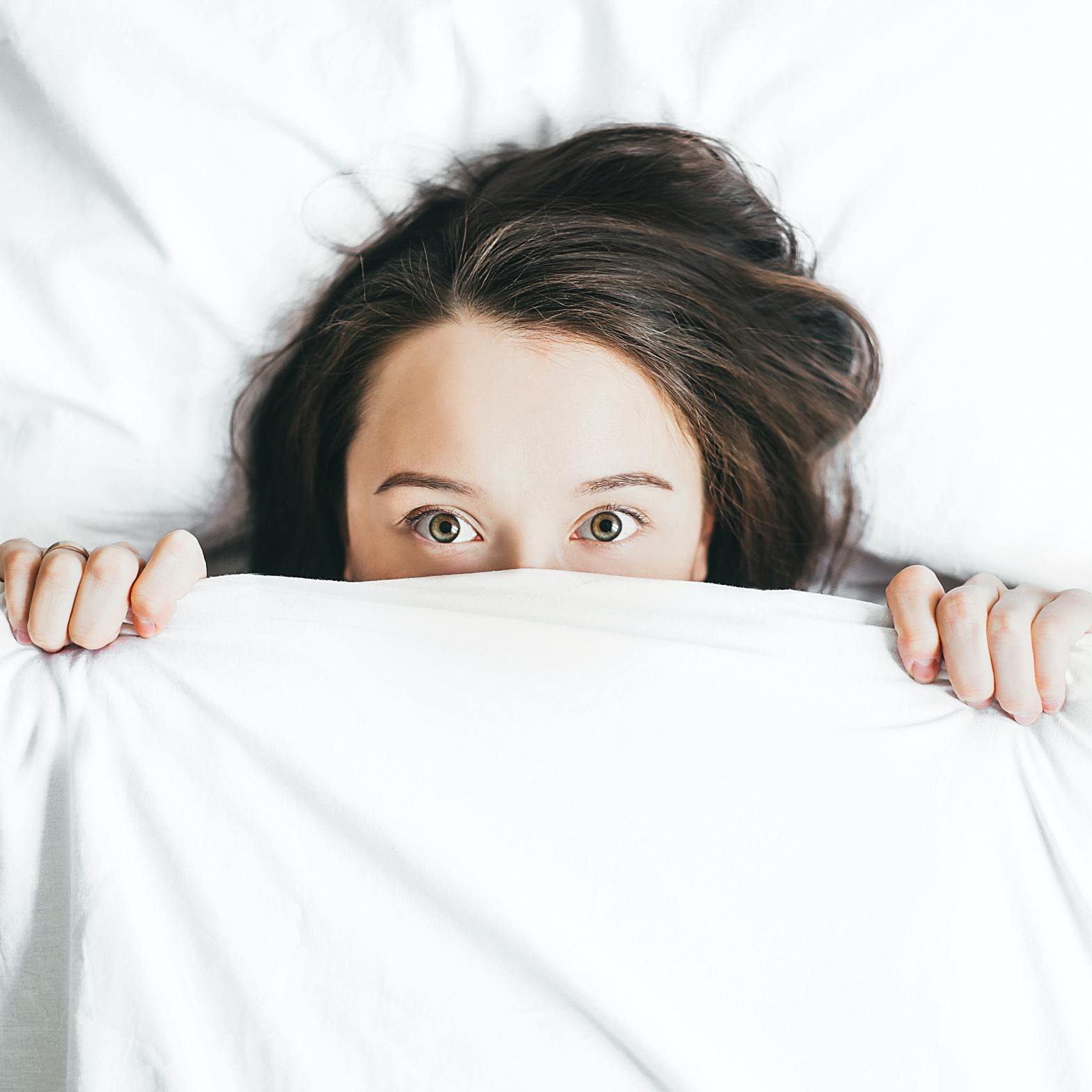
fashion people woman relaxation
Photo by PNW Production on Pexels.com

3. Self-Hypnosis. If you are only familiar with hypnosis that you might have seen on films, forget about it. Hypnosis is a state of consciousness where someone is intensely focused on an idea, which can make their brain more receptive to new thoughts or ideas. If you want to try it, there are apps or tutorials on YouTube available.

4. Breathing Exercises

You probably know that a deep breath can help you stabilize your breath when you are anxious or worry about something deeply. A breathing exercise can help encourage relaxation, reduce muscle tension, and even lower your heart rate and blood pressure. Repeat this as many times as you need. By practising deep breathing, you reproduce your breathing patterns as you fall asleep. In doing so, you encourage your body to enter that state of restfulness and get itself ready for sleep.

5. Progressive Relaxation

This technique allows you to become more familiar with your body and any of the places you may be holding onto stress or tension.

Progressive relaxation involves working with your body in different areas and each muscle group, first by tensing the muscles and then relaxing them. Usually you start with your feet and go your way up to the top of the head. In this way you will be aware of how the parts of your body feel when they are tense, as well as when they are relaxed. You can use this technique to address any tension or stress you may have.

6. Yoga Nidra

Yoga Nidra is also known as yogic sleep. It helps the body relax while the mind is alert and awake. The goal is to guide yourself through the main four stages of brain wave activity— beta, alpha, theta, and delta— and achieve a state of being between wakefulness and sleep.

To practice Yoga Nidra, all you need is a comfortable place to lie down. Begin then by lying face-up and set an intention for that session, for example stress relief or relaxation. Watch your body and notice any tension or sensations you feel. You can always find apps or tutorial on the Internet to guide you through this practice.

One study has shown that Yoga Nidra can be a very effective supplemental treatment for insomnia. In participants practicing Yoga Nidra, regular participation improved their sleep quality and reduced their insomnia severity, anxiety symptoms and their stress levels. This improvement even continued 3 months after they began practising.

Remember not to practice any of these relaxation techniques while operating machinery, driving a car, or doing anything that requires your full attention.

Have you ever heard of any of these techniques before?

photo of woman laying on ground
Photo by Natalie on Pexels.com

How and Why You Should Listen to Your Body

In our times, we receive information from many sources: emails, social networks, television, people we know and colleagues. Our mind is over-stimulated for the duration of the day and this can cause stress and anxiety, which can also cause a real burn-out.

The excessive exposure to those information is detrimental to the activity of our body which is relegated to a mere container of organs that allow us to move (even if sometimes less than what we should).

Too many hours spent in front of the screen (mobile phone, computer or television) do not allow the body to tone up and therefore regenerate. During the pandemic, it has become even worse, because of the restrictions imposed to avoid the spreading of the virus. We could go out less often, or not at all.

Furthermore, it can happen that we ignore the pain from the body by using analgesics or other types of medicines to avoid feeling sick.

crop patient taking pill from table
Photo by Artem Podrez on Pexels.com

If you do this, know that you are waging war to yourself, because silencing your body will not help you solve the problem.

Our body is sending us important signals that we will need to start considering. By continuing to ignore the messages it sends us, there may come a time when the pain becomes unbearable and it might be too late.

As soon as you hear a strange noise coming from your car, you take it to the mechanic before it breaks down. The same thing you should do with your body.

For example, if you experience often back pain, it means that you need to change your position, adopt a more adequate posture, maybe change chairs or just go for a walk.

Try to think that pain is actually your ally because it wants to tell you that there is something wrong with you and which you should take care of.

Let’s see four techniques that you can use every day to learn listening to your body.

Mental scanner. This is a mindfulness technique that involves mentally scanning of your body from the top of your head to the bottom of your toes to check if each part is healthy.

Daily walks. This is the best way to get up of your chair. Usually all mobile phones have an app to calculate steps. I signed up for a monthly “race” with colleagues to take at least 6,000 steps a day. At the end of the race, there will be an award for the walker who has taken the most steps. Run a race with your friends or colleagues too!

Feeding your body and mind. The Japanese eat up to 80% of their hunger in order not to get heavy (this is a principle of Ikigai). Therefore, eat less but eat healthy, and sleep at least six hours a night so that your body and mind can do a complete “reset”.

Respect the messenger. Instead of taking medicines at the first symptom of discomfort or pain, try listening to your body, what it is communicating to you. Think that your body needs to be considered and looked after. Don’t wait for your body to ask you for help when you are in extreme pain, as remember that it might be too late.

When you don’t feel well, what do you do? Do you listen to your body or you take medications?

namaste sign on wall
Photo by Mikhail Nilov on Pexels.com

Why You Should Accept Your Insecurities

“All I have achieved in life has been thanks to good luck”. “My colleagues are better than me”. “I cannot believe my colleagues complimenting me on a job well done.”

Does it sound familiar to you? If you think that everything that happens to you is due to chance and good luck you are probably someone with an external locus. You may feel insecure in one area of your life, personal or professional, or in both areas. Maybe you think being unable to manage a project (remember that the best solutions come after unsuccessful events) or that a person you like does not want to talk to you (but have you ever tried approaching them?).

Insecurity does not always come with the same intensity. It ranges from an unpleasant feeling to a real paralysis, for instance when you have to make a presentation in front of a big audience or when you do not have the courage to talk to someone you like.

Photo by Samuel Pereira on Unsplash

However, insecurity can become your ally if you know how to turn it in your favour. The first step is to recognize that you are insecure. Try to think objectively about your successes, big or small. At the beginning, you felt insecure but you succeeded thanks to your will and determination.

Continuously complaining, looking at others success, constantly thinking that you are unlucky certainly does not help you. Perhaps you will not be able to control your insecurity in any situations, but try to change your attitude, take it into your hands, look at it and say, “Yes, I can do it!”

Accepting yourself for who you are with all your strengths and weaknesses, even if you do not like them, will help you overcoming insecurity.

Are you ready to challenge your insecurities?

Photo by Slava on Unsplash

How Our Idea of Life in the City Has Changed During the Pandemic

Covid has radically changed our way of life in the city. Consequently, also our relationship with the city has changed.

If you were willing to pay more for a down-town rent or to buy a small apartment to live in the city, would you do the same today?

Data on home purchases in Belgium show that people during the pandemic wanted to buy or rent properties in the countryside, where homes are cheaper and bigger. Nature is a source of energy that can help us in difficult times such as those of Covid.

If being able to have a quick aperitif after work, to go out for dinner in the evening without having to travel too many kilometres, or going to the cinema or a concert, justified the fact of living in small apartments, where you are exposed to not always easy coexistence with the neighbours and outside noise and traffic, is this still the case now?

Cities during the pandemic have turned into places to mainly work and sleep. Maybe you started asking yourself, what kind of life is it?

If you were able to go to work during the pandemic, didn’t you have the impression of living in the office? If, on the other hand, you have always worked from remote, don’t you think that you have been experiencing difficulty in finding work-life balance?

With the rules of lockdown even using public transport was a problem, due to the fear of contagion. We started to do shopping close to home.

Photo by Matt Seymour on Unsplash

Staying at home all the time and respecting the rules of lockdown have caused spreading of anxiety in a worrying way. In fact, it has been proven that living in the city makes you feel more isolated, even if the opposite would seem to be true.

For a long time we have been deprived of our need and desire for sociability, our walks have been reduced to the tour of the neighbourhood to fulfil our daily commitment to take 6000 steps or not to forget the challenge of staying healthy despite everything.

Things as common as eating with friends or colleagues, going to the cinema or shopping, have turned into extraordinary things.

Is that why living in the countryside has perhaps become more popular? Would spending less on a house with a garden and nature nearby make you change your mind about living in the city?

Photo by Badiuth on Unsplash

How and Why You Need to Learn to Take Better Care of Yourself

The education we have received has taught us that we must treat well the others. But why the others and not ourselves?

Are you your own worst critic? Do you sometimes insult yourself for something you did wrong or wanted to do better? Do you eat poorly, sleep little, abuse of harmful substances (alcohol, tobacco)? Or are you simply worried about pleasing others? Know that you are not alone. This is a common problem and normal to a certain extent. Because of this, it would be useful to pay attention to some daily details to learn how to look better after yourself.

As I was saying before, we have not been taught to take good care of ourselves. We put often aside our well-being. How many times have your parents told you to look well after the others or do things for the others? How many times, on the other hands, have you been told that you must also take care of yourself?  

The way you look after yourselves is a kind of extension of what you have learned from your parents, teachers or caregivers.

For a very young person this may seem exaggerated, as some basic principles of self-esteem are taught in schools today. Some parents also try to instil some self-care virtues in their children.

However, for an adult or elderly person, taking care of themselves well and being truly respectful of themselves is not always something they have consciously internalized. In the past, it was not so easy to find someone who could help you cultivate a certain self-love without it being considered selfish.

In fact, this is precisely the basis: self-love, not to be confused with narcissism or egocentrism. To better understand this concept, we can first imagine what we do when we really love someone: we seek their happiness, we help them, we try to make them feel good, and we accept them as they are, with all their imperfections and qualities. Actually, looking well after yourself means really accepting yourself for who you are.

Becoming kind towards yourself, means understand yourself, especially when you face failures and mistakes.

Photo by Klimkin on Pixabay

That attitude can be a great ally. You can challenge yourselves in a healthy way, taking into account your possibilities, your desires, and not the desires that others have for you.

The use of language is very important to achieve the goal of taking good care of yourself. It is common, and to some extent normal, that on some occasions you speak “badly” to yourself, you do it unconsciously. You cannot talk to yourself always in a loving way, as you could enter into toxic positivity (when a positive attitude is used to mask negative emotions, namely pretending that all is well when it is not).

However, you must not use words that hurt yourself. Nobody insults those who truly love, right? Talking to yourself and thinking badly about some personal aspects (physical or mental), and constantly reiterating it, can in the end make you really believe it.

Taking care of yourself is essential. This implies developing a healthier and more suitable lifestyle. Sleeping and resting enough hours, for example, as well as eating well based on our weight, age and lifestyle, not abusing alcohol or tobacco, are all ways to take care of yourself. Taking time to relax, reconnect with what you really like to do, keep your hobbies, follow your passions and interact with people who bring you something positive in your life means being respectful of yourself.

What about you? Do you take good care of yourself?

Photo by Freestocks on Unsplash

Why Your Well-being Must Be a Top Priority

The society we live in often leads us to reverse priorities and put work first. This can negatively affects our quality of life and physical, mental and emotional health.

According to researches carried out in France, physical suffering related to work affects 3.1% of women and 1.4% of men, but according to some experts, the figures are higher. The international classification of diseases identifies burn-out as a work-related phenomenon but in reality work is not the only cause.

With the cost of living constantly rising, we are likely to work longer hours to earn a salary that allows us to provide for our own needs and those of our family. Because of this, many elements of our private life are put aside.

We spend many hours working, reducing the time to eat, to rest, to be with the family, and we do not realize how much this can harm us.

While most of us cannot afford to leave their job, a balance must be found between work and private life to prevent stress from building up in a worrying way.

Photo by Christin Hume on Unsplash

In this period of forced tele-working, it is even more difficult to put boundaries between work and private life. For this reason, many governments have been drafting directives that establish the right to “disconnect”. We need to have the time to do sports, to walk, to take care of our dear ones, to follow our passions or simply to rest.

More and more people suffer from stress, feel exhausted, have problems with nutrition, addictions, or relationship difficulties, and all that because of the long working days, which do not leave us the time to do activities for our well-being.

If you feel you are in one of those situations, know that no salary is worth your health, no job is worth the wear and tear that comes from working days that annihilate your energy and happiness.

If you have no other alternatives to the work you are currently doing, find something positive to balance your life, because otherwise, there may come a time when you will start making mistakes at work and your overall performance will suffer. Start looking for another job but put your health in the first place, because if you get ill it may take a long time to recover.

Your job is an important part of your life, but it is not your life. There is much more: family, health, and friends. Do not allow work to take up all the space in your mind and body, taking the joy away from you.

Remember always taking care of yourself first, because this is the only way you can live a better life.

How do you take care of yourself?

Photo by KT on Unsplash

Late Bloomers: Instructions For Use

There is a direct relationship between ageing, physical, and mental activity. People who adopt a sedentary and passive lifestyle after retirement accelerate their ageing process. Lack of movement diminishes the body’s responsiveness and few social relationships inhibit intellectual abilities.

If we add also loneliness, the ageing process accelerates. Spending the day without stimuli other than television or cell phone, without seeing anyone or going out can cause you to lose motivation to take care of yourself and your health. Many of the illnesses we attribute to age are not due to age.

On the other hand, an active and purposeful person (a person with a purpose of life – ikigai) keeps connections and maintains healthy habits.

Photo by Alex Perri on Unsplash

Therefore, to keep fit, why don’t you follow those three tips coming from Japan?

1.  Give yourself a goal for your next birthday. For example, you may decide to practise some moderate physical activity every day to lose weight and reach that goal by your birthday. In addition, sport promotes the production of endorphins, the hormones of happiness.

2.  Reconnect with nature. Practice shinrin yoku at least once a week, or immersion in a forest recommended by Japanese doctors to promote longevity. Furthermore, this practice can also protect you from diseases because the proximity to plants strengthen the immune system.

3.  Be grateful. In the same way that an attitude of complaining and constant anger increases the level of cortisol (the stress hormone), an attitude of gratitude towards life and the people around us, promotes serenity and the joy of living.

Remember that life expectancy is statistically high in our Western societies. Most likely, you still have two good decades of “useful” life left after retirement that you could fill with meaning and activity.

Ageing with care is an art. The third age, which I prefer to call third youth, can become an opportunity to be able to love you more and take better care of yourself. Find something you enjoy doing or that you can attach an immediate reward to, and involve friends to add the lovely component of socializing.

What are your plans for your third youth?

Photo by Joanna Kosinska on Unsplash

The Trap Of High Expectations

Our brain does not like uncertainty. We are programmed for survival but we cannot move on if what surrounds us is not clear. To reduce the uncomfortable feeling that a lack of certainty generates, we create expectations. However, relying on our expectations does not always help us feel better. Our expectations affect us more than we imagine. They affect our learning, our perception, and how we treat those around us.

Our expectations can become a source of frustration. For example, you definitely want to see a movie because you have heard great comments about it but after watching it you find out that you actually did not like it that much, so you feel disappointed. If you go to eat in a famous restaurant, then the food does not seem to you so well prepared, you are disappointed (and you may have spent a fortune).

Expectations are said to be anticipated resentments, because when reality does not match your expectations it causes you frustration.

In marketing, customer satisfaction is defined as the result of perception minus expectation. The higher the expectation, the higher you will have to set the bar of experiences or relationships in order to be satisfied. This is an unconscious mechanism, but there are ways to act on your way of thinking, so that it could play in your favour.

Let’s see how they can help you in the context of the current pandemic.

1. Trust that soon the pandemic will end, thanks to the progress of vaccination. Do not get obsessed by setting an end date though. Now in Europe they are talking about mid-July, but can how you be sure? Do not let your happiness depend on the end of Covid.

2. Replace expectations with gratitude. Be grateful that you did not get sick, that you have a house to live in, that someone loves you. Look at the little details of your daily life and you will surely find something to be grateful for.

Living without so many expectations is easier because you value what happens to you in that moment without being influenced by the idea you created before. This does not mean abandoning your dreams or desires. You must keep them as a beacon that guides you in the decisions about your future, but you shall not make your happiness depend on external factors that are beyond your control.

Can you let go any of your expectations?

Photo by Cortney Corlew on Unsplash

What I Have Learned From Leonardo da Vinci

Leonardo da Vinci was the most creative genius in history. Of course, saying that I learned things from Leonardo is perhaps a bit risky, because in fact Leonardo is the very embodiment of genius.

As we know, Leonardo lived in a particular era for humanity, the Renaissance, when literature, philosophy, science and the fine arts experienced an unprecedented splendour. Italy was in full economic momentum and Florence became the capital of fine arts.

Leonardo was born not far from Florence, in Vinci in 1452. In Florence, he learned painting, sculpture, architecture, music, nature, science, geography, poetry and who knows what else. After all, we know he was a genius, right?

Let’s see some of his main masterpieces:

1. The Last Supper, a mythical painting, difficult to preserve because Leonardo used a technique of his own invention that, however, proved to be inappropriate.

2. The Vitruvian Man, a drawing that illustrates the proportions of the human body.

3. The Gioconda, also known as the Mona Lisa, one of the most famous and seen artworks in the world.

Photo by Markuns Baumeler on Pixabay

Other works are less famous but not less important:

  1. The Codex Atlanticus, which brings together the largest collection of Leonardo’s writings and drawings.
  2. His futurist inventions such as the helicopter, the plane and the submarine.
  3. The huge statue depicting a horse: 70 tons of bronze and 7 metres high.

Why Leonardo wanted to make these works, so different from each other?

I think he was mainly driven by the curiosity to experiment and discover new horizons. He loved creating and doing things with his hands. He loved dreaming, designing, building and putting wings to his ideas.

Taking care of all his projects, one after the other and sometimes even in parallel, represented for Leonardo his life’s purpose.

The lesson that Leonardo taught me is that in life you have to try, make mistakes, do not give up and start over again to move forward. It does not matter how many difficulties you may face. Surely, Leonardo had to go through a series of failures to achieve his project. I am sure that determination and perseverance were also some of his skills. Look at what he left us, all the works that gave him the title of genius of all time.

You may not forget your failures, but to progress you can learn from them.

What are the lessons learned from your life?

Photo by Bessy on Pixabay

How the Pandemic Has Changed Our Lives

It is undeniable that the restrictions imposed by the ongoing pandemic have drastically changed our habits and our lifestyle. There is no doubt that the stress produced by uncertainty, prohibitions and lockdowns, whether partial or total, have prompted us to search for distractions that can give us some relief. As Ovid said, human beings seek what is forbidden and desire what is denied them.

There is a thread that links excessive behaviors (drinking too much, smoking too much, overeating, spending too much time on the computer or watching television) to stress.

Photo by Christin Hume on Unsplash

Clearly, the pandemic puts our desires on hold and it is normal to wish for what cannot be done. Only when we go back to a more or less normal life and our desires will be satisfied, our lives will be brighter. The pursuit of pleasure is an absolutely human behaviour, there is nothing to worry about.

Our brain identifies and reinforces beneficial behaviours such as eating well, socializing, having fun. This complex reward circuit that generates pleasure is the result of the evolution that guarantees our survival, that orients us in daily life and that keeps us going on. The more we can produce dopamine (the pleasure and reward hormone), the more we can generate pleasant sensations in a natural way. As a consequence, we would not need to adopt excessive behaviours that can lead to addictions.

However, the situation we have been experiencing for about a year has affected and affects motivation and self-control. We are no longer able to generate pleasant sensations and situations naturally and we have to look for different means to improve our life condition. The sudden lack of dopamine results in a short circuit of pleasant sensations which then pushes us to seek pleasure in another way.

It is important to be careful that these behaviours do not turn into addictions. Luckily, few people drive themselves to the point of becoming addicted to new harmful habits.

To prevent addiction it is necessary to put in place strategies that favour self-control, especially anti-stress strategies. Practising physical exercise, walking in the nature, trying not to isolate yourself but to maintain contact even remotely, are just some suggestions.

Do you have any anti-stress strategies? Let me know!

Photo by Maarten van den Heuvel on Unsplash