
Why Cultivating a Garden or a Vegetable Garden Is Good for Your Health

Plants improve the air we breathe and can be a place to grow vegetables. Therefore, green spaces have been increasing recently in urban spaces thanks to the creation of rooftop gardens.

For those who live in the city, the importance of having a green space close to home has become necessary during the lockdown due to Covid. From London to New York, parks and public gardens have always offered a precious refuge in the asphalt jungle of the streets, shops and offices that make up the typical urban landscape. But apart from these oases of peace, there is not much room left to become “greener”, which is why we are witnessing the development of rooftop gardens.

From improving physical and mental health to bringing communities closer passing by fighting pollution, the creation of green spaces at the top of the buildings can be truly seductive.

low angle photo of four high rise curtain wall buildings under white clouds and blue sky
Photo by Philipp Birmes on Pexels.com

Here are some benefits you can get from growing a rooftop garden.

They help purify the air

All cities in the world face the same challenge: maintaining quality of life despite the high pollution rate and rising CO2 concentrations. For this reason, planting trees or shrubs on the roofs can be useful to exchange carbon dioxide for pure oxygen. In addition, roof gardens can also improve the insulation of the building, reducing heat loss in winter and maintaining a cooler temperature in summer. In this way, besides making a gift of oxygen to the environment, you will lower the consumption of electricity and heating, paying less expensive bills.

They offer shelter to wildlife

Loss of natural habitat is a threat to wild animals in general.

A roof garden can quickly become a refuge for bees, butterflies and birds, where they can rest and nest, thus keeping the pollination cycle active, which is essential for human nutrition.

They allow you to grow your own vegetables

Tomatoes, courgettes, peas and strawberries, all organic. The fact of sowing and growing your own vegetables is an incredibly rewarding activity that allows you not only to save money but also to eat healthier.

They inspire engaging actions for communities

Why not thinking about involving the primary school close to home by inviting children to discover your garden or vegetable garden? You will be surprised to see the enthusiasm of the little boys and girls. Gardening is a real contribution to integration into the local community. Where I live in Brussels there is an association called Parck Farm that has taken over a greenhouse and created a botanical garden. In addition, it offers small plots of land to cultivate. We share the land together with Belgians of several origins, Poles, Portuguese, … The association also offers the possibility of organising team building activities there. Participants can help members of associations to remove weeds, collect garden products, prepare the soil for winter. Educational activities for boys and girls are regularly scheduled to make them discover the wonders of flowers and plants. Workshops for the preparation of creams and syrups are other events organized by the association to promote integration among the inhabitants of the neighbourhood.

They improve physical and mental health

We all know that spending time in nature revitalises the body, spirit and soul. This practice is known as shinrin-yoku (forest bath) in Japan and has been validated by scientific research. In 2019, a study revealed that spending at least 120 minutes a week (the equivalent of about 17 minutes a day) in nature can have a significant impact on our health and general well-being. Other research has established a link between regularly visiting green spaces, improving sleep and decreasing negative thoughts.
Do you think that those benefits are a good reason to launch yourself into the cultivation of a green space?

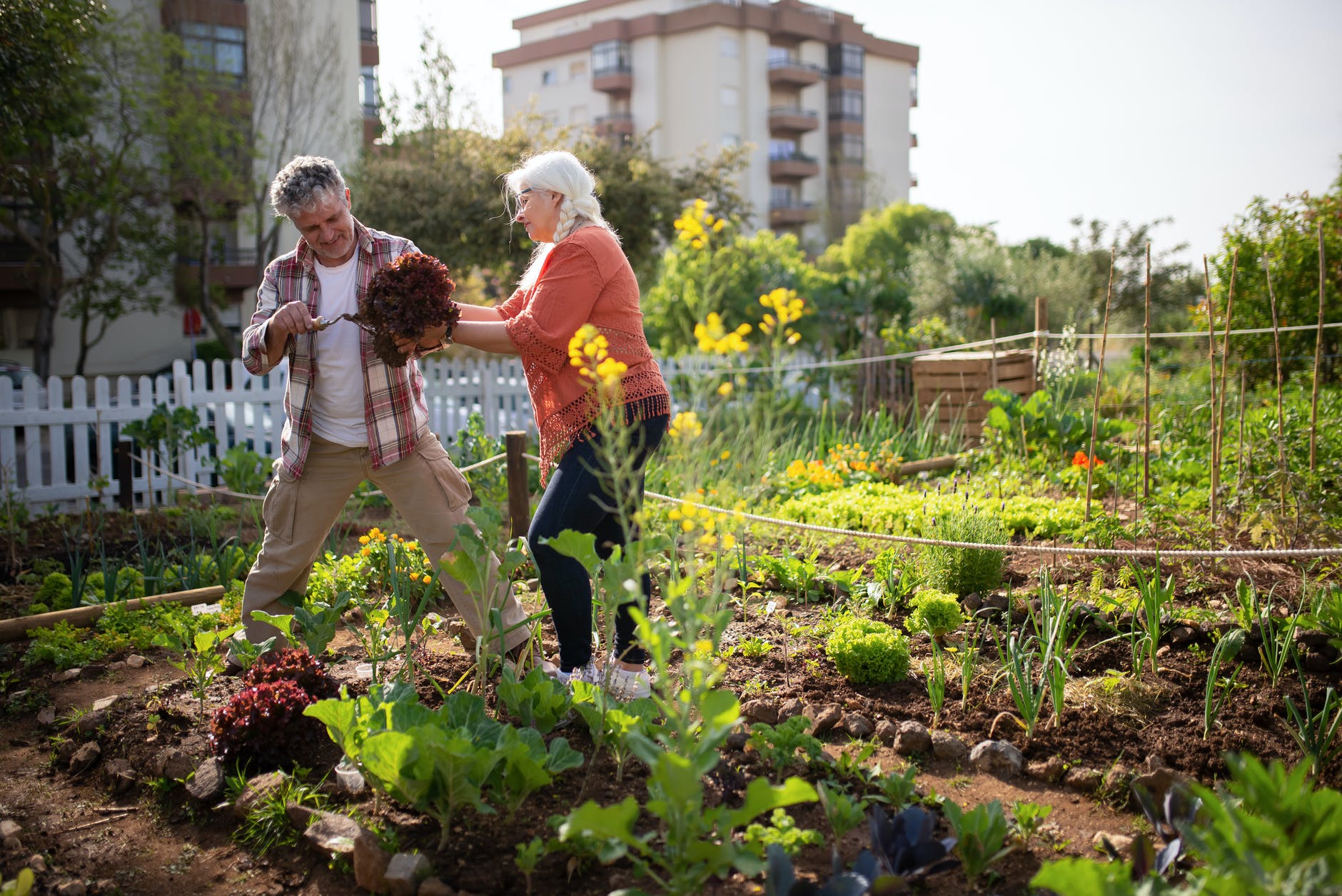
a couple in a vegetable garden
Photo by Kampus Production on Pexels.com

Working Less, Could it Save the Planet?

A study by the University of Massachusetts states that “working less is good for the environment”. If we would spend 10% less of our time at work, our footprint on the earth would be reduced by 14.6%, mainly thanks to the decrease in travelling and daily expenses.

There are two contradictory theories on this idea:

  1. wages may remain unchanged and the economy would continue to grow thanks to the technological and energetic improvements despite the reduction in working time; this theory explains us that pollution could be reduced thanks to the change in daily habits, such as the preparation of your own meals at home instead of buying food already prepared or prepared by others;
  2. only by reducing wages we will achieve a significant reduction in the ecological footprint by 2050. This is the theory of degrowth that supports the fact that only with less money available the consumption of material goods can be reduced and consequently there will be a corresponding reduction of the pollution and use of resources. In practise, it means that by working four days, you would receive a salary equivalent to four days.

I would like to focus on degrowth because I support this approach. It seems clear to me that by continuing in this way the human kind will encounter a rapid depletion of available resources which will cause a sudden and uncontrollable decline of the population and of the productive capacity of the industries. The degrowth theory is certainly radical and to some it seems heretical. However, an OECD report says that consumption has increased by 50% in the past 30 years and that this goes hand in hand with an increase of the environmental footprint. The degrowth theory stipulates that a progressive decrease in consumption should begin by starting with a reduction in working time.

Serge Latouche, economist among the founding fathers of the degrowth theory, explains that degrowth does not mean weakening or suffering. It rather means transforming the concept of consumption into that of use: I buy something because I need it, if it breaks I have it repaired ( or repair it by myself) and, at the end of its lifecycle, I recycle it. It also means shifting attention from quantity to quality. The result will be a materially responsible society.

Degrowth is also a praise of slowness and duration; learning from the past; awareness that there is no progress without conservation; indifference to fashions and ephemeral; draw on the knowledge of tradition; not identifying the new with the best, the old with the outdated; do not call buyers the consumers , because the purpose of purchasing is not consumption but, as I said before, use.

So why working less and earning less? If the consumption for leisure or pleasure activities would increase thanks to a shorter working week, there would be a significant increase in the ecological footprint. This is why the reduction in working time must be accompanied by a reduction of wages. However, we would have more time for us, to dedicate to our personal growth, which does not only mean fun or leisure activities.

The crucial choice of our times, therefore, is between urgently committing ourselves to embark on the path of sobriety at all levels or going at full speed towards the depletion of resources and the global collapse of our system, which nobody hopes for.

In these difficult times, with the rapid spread of a virus that threatens our lives and frightens us, we could seriously begin to reflect on a different future for us all.

What do you think about it? Would you be willing to work less, gaining less and consuming less (but using more), thus starting a path towards a more committed society, different from the way we know it today?