How to Make Others Happy

Making others happy is simpler than you might think. There is a scientific explanation behind the phrase “a smile is contagious”. Researchers at Harvard University have found that happiness is contagious: when a person is joyful, people around them are 25% more likely to be happy as well. Imagine what could happen if every person in the world would do one act of kindness a day to another person. The repercussions would be staggering. You would not need to do great things, as even small gestures may make others smile.
Try these ideas to see if you would bring more happiness around you.

How to Make Others Happy #1: Sharing Books

Two Australian friends wanted people to quit the habit of watching their phones on the public transport and replace them with a good book. That is why they launched @booksontherail. This initiative invites people to place a sticker on a book they liked and leave it somewhere for someone else to pick it up and read it. After reading it, the book could be left again somewhere for another person. Why not give it a try? Next time you finish a good book, instead of leaving it on a shelf to gather dust, leave it somewhere and invite with a post-it the person who finds it to read it, and continue the literary chain of happiness.  

In Brussels, there are small free “book shelves” on the streets where people can exchange books for free, of course. If you live in an apartment, why not set one up in the lobby of your building, or why not also at work?

How to Make Others Happy #2: Giving Compliments

“If you think something positive about someone, you should tell them,” says Steven Bartlett, who runs one of Europe’s biggest podcasts, Diary of a CEO.  “It’s the easiest way to add positive things to a world that needs it so much.”

How to Make Others Happy #3: Making a Cake

Why not bake a cake for your colleagues? Don’t wait for a reason, just make it to share a few moments away from your work and simply enjoy a piece of cake together.  In addition, sharing food has been shown to increase happiness.

How to make others happy #4: Sharing your Garden

Take a little branch of your favourite plant from your garden or balcony and give it to a friend to integrate a part of your world into their world. Every time they look at it, they will think of you and they will put a smile in their face.

How to Make Others Happy #5: Pay for a Coffee In Advance

A “caffè sospeso” is a “hanging coffee” in Italian. This term was created in the workers’ bars of Naples more than 100 years ago. Some people will pay for two coffees while having only one so that people in need could enjoy the second one for free. When you order a coffee next time, ask the waiter if you can buy one for someone else as well. Some bars have regular visits from homeless people to whom they can offer your coffee.

How to Make Others Happy #6: Opening Doors

By “opening doors” I don’t mean metaphorical doors, I really mean opening a door for someone else who is behind you. “Something as simple as keeping a door open for someone else coming in can really lift both spirits,” says psychologist Jess Baker. “It only takes a few seconds, but it’s a moment of connection that shows that you’ve seen the other person, that you’ve taken them into account, and that you’re doing something to make their day more pleasant.”

What would you do to make others happy?

two coffee latte
Photo by Anna Urlapova on Pexels.com

Ideas to Try out in Your Free Time (part four)

The journey to explore ideas to try in your free time continues today. Other ideas have been published earlier. Let’s check them out!

Here are some new ideas to try out in your free time.
  1. Organize a picnic. Choose a date, a place and invite your friends and/or family. The formula, particularly convivial, is declined in many ways and can integrate a theme, a specific culinary style, a walk, or even games for the youngest and, why not, also for the older.
  2. Take a trip alone. This may seem like a very bold big step if you are used to travelling with your partner, family or friends. The advantage is the incredible freedom to really do what you want, not to compromise with others on what you want to do, and to plan an itinerary only according to your wishes.
  3. Read a book outdoors. Choose a comfortable place, a park with a beautiful lawn for example, and take a blanket to sit on. Take advantage of your time to read a book by occasionally looking at the people around you, walking, children playing, dogs running. Enjoy the life that unfolds around you, without you having to do anything. And if you finish the book, why not leave it on a bench with some advice for those who want to take it?
  4. Cultivate your own garden. Whether you want medicinal plants, vegetables or flowers, making a garden is fun and instructive. If you don’t have land, you can also do it on a balcony. And if you do not have a balcony either, there are plants that live well also inside. This activity is particularly healthy because it allows you to regain contact with nature, to understand its dynamics and to observe its wonders.
  5. Immerse yourself in nature. As I said before, being in contact with nature is extremely energizing, relaxing and reassuring. Whether it’s a walk in a forest, in a park or a full immersion in nature, like camping, listen to your wishes and make them come true.

Would you have other ideas to add? Let me know!

close up of beer bottles on wood
Idea – Photo by Bruno Scramgnon on Pexels.com

Why Cultivating a Garden or a Vegetable Garden Is Good for Your Health

Plants improve the air we breathe and can be a place to grow vegetables. Therefore, green spaces have been increasing recently in urban spaces thanks to the creation of rooftop gardens.

For those who live in the city, the importance of having a green space close to home has become necessary during the lockdown due to Covid. From London to New York, parks and public gardens have always offered a precious refuge in the asphalt jungle of the streets, shops and offices that make up the typical urban landscape. But apart from these oases of peace, there is not much room left to become “greener”, which is why we are witnessing the development of rooftop gardens.

From improving physical and mental health to bringing communities closer passing by fighting pollution, the creation of green spaces at the top of the buildings can be truly seductive.

low angle photo of four high rise curtain wall buildings under white clouds and blue sky
Photo by Philipp Birmes on Pexels.com

Here are some benefits you can get from growing a rooftop garden.

They help purify the air

All cities in the world face the same challenge: maintaining quality of life despite the high pollution rate and rising CO2 concentrations. For this reason, planting trees or shrubs on the roofs can be useful to exchange carbon dioxide for pure oxygen. In addition, roof gardens can also improve the insulation of the building, reducing heat loss in winter and maintaining a cooler temperature in summer. In this way, besides making a gift of oxygen to the environment, you will lower the consumption of electricity and heating, paying less expensive bills.

They offer shelter to wildlife

Loss of natural habitat is a threat to wild animals in general.

A roof garden can quickly become a refuge for bees, butterflies and birds, where they can rest and nest, thus keeping the pollination cycle active, which is essential for human nutrition.

They allow you to grow your own vegetables

Tomatoes, courgettes, peas and strawberries, all organic. The fact of sowing and growing your own vegetables is an incredibly rewarding activity that allows you not only to save money but also to eat healthier.

They inspire engaging actions for communities

Why not thinking about involving the primary school close to home by inviting children to discover your garden or vegetable garden? You will be surprised to see the enthusiasm of the little boys and girls. Gardening is a real contribution to integration into the local community. Where I live in Brussels there is an association called Parck Farm that has taken over a greenhouse and created a botanical garden. In addition, it offers small plots of land to cultivate. We share the land together with Belgians of several origins, Poles, Portuguese, … The association also offers the possibility of organising team building activities there. Participants can help members of associations to remove weeds, collect garden products, prepare the soil for winter. Educational activities for boys and girls are regularly scheduled to make them discover the wonders of flowers and plants. Workshops for the preparation of creams and syrups are other events organized by the association to promote integration among the inhabitants of the neighbourhood.

They improve physical and mental health

We all know that spending time in nature revitalises the body, spirit and soul. This practice is known as shinrin-yoku (forest bath) in Japan and has been validated by scientific research. In 2019, a study revealed that spending at least 120 minutes a week (the equivalent of about 17 minutes a day) in nature can have a significant impact on our health and general well-being. Other research has established a link between regularly visiting green spaces, improving sleep and decreasing negative thoughts.

Do you think that those benefits are a good reason to launch yourself into the cultivation of a green space?

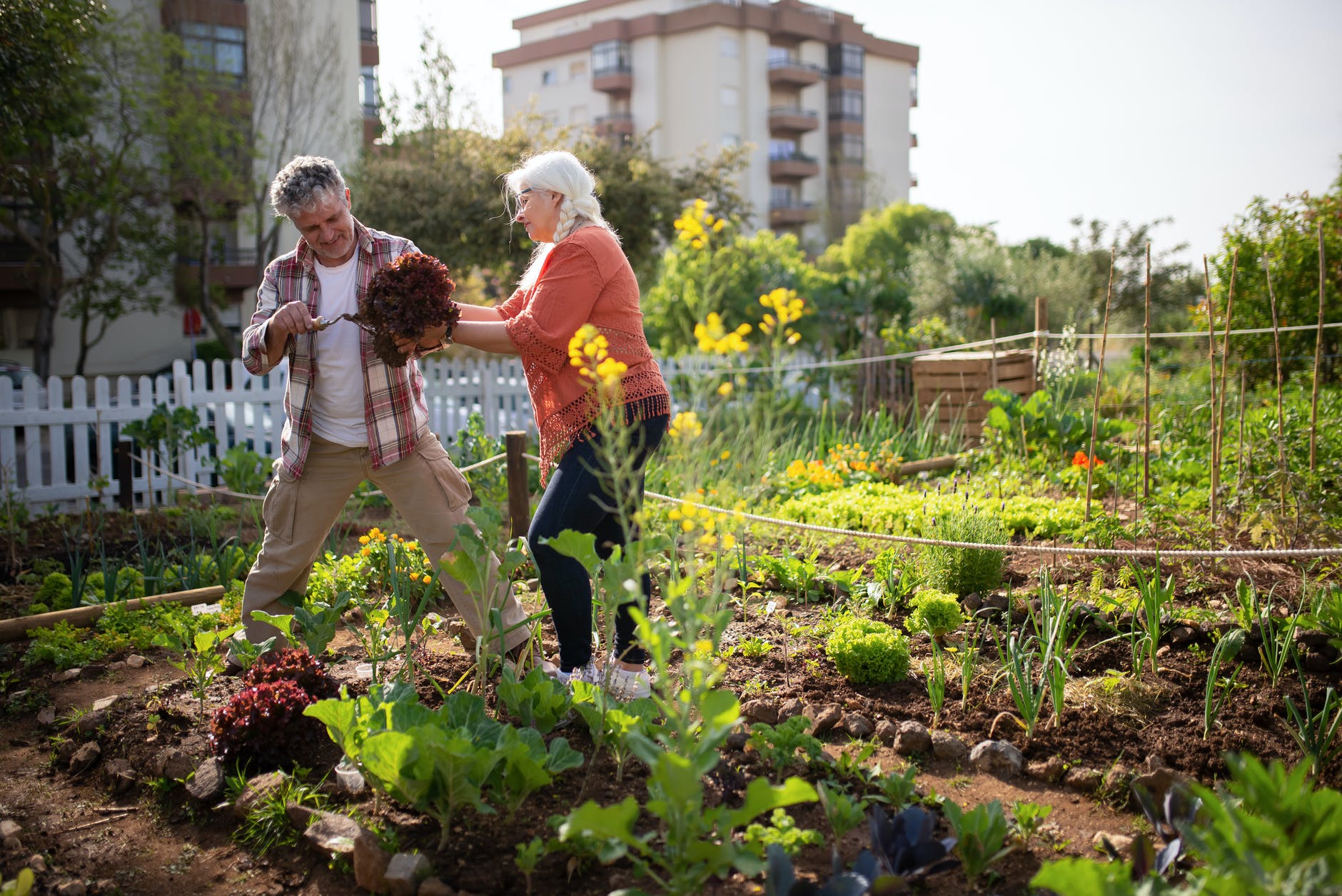
a couple in a vegetable garden
Photo by Kampus Production on Pexels.com