
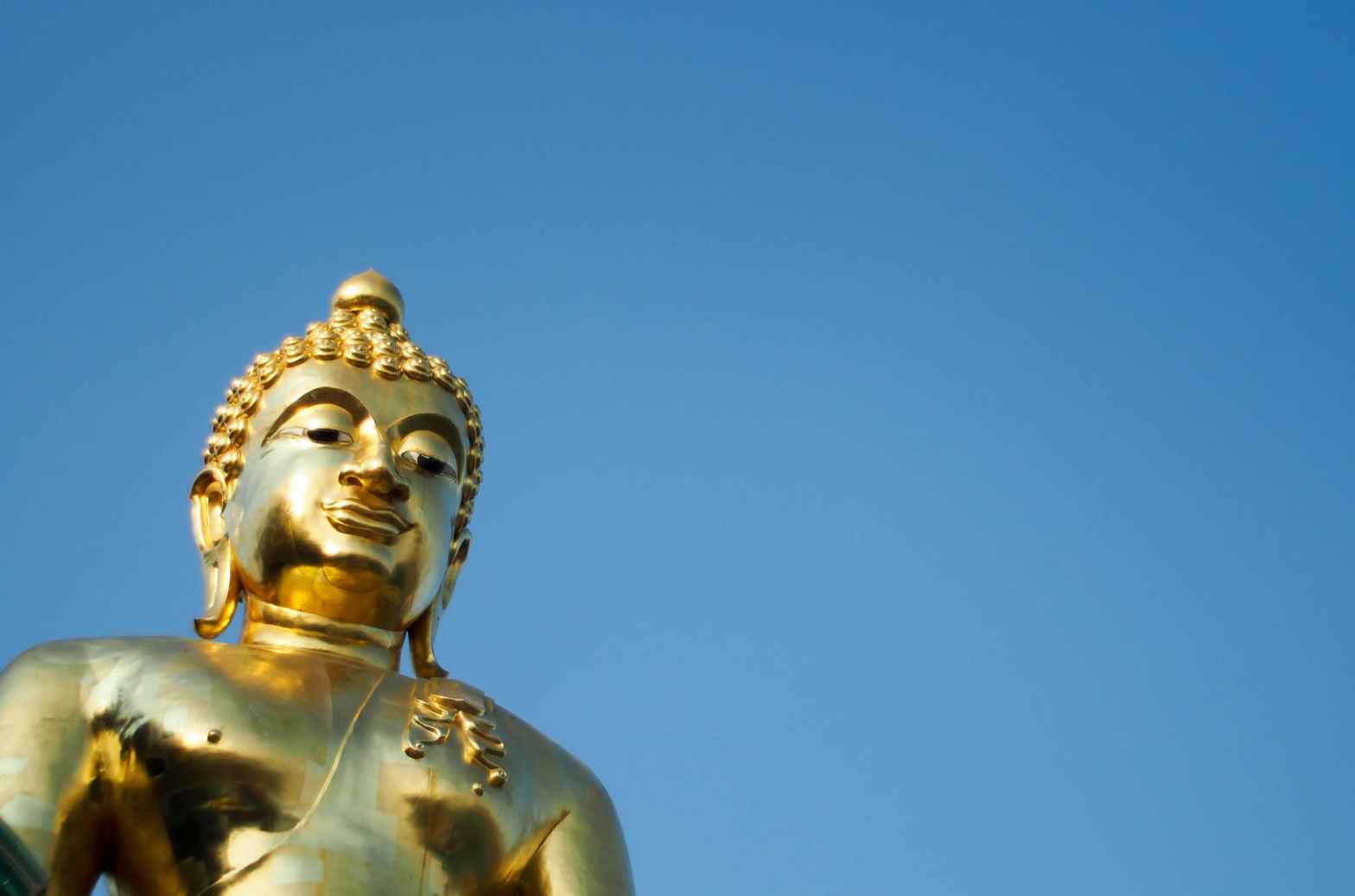
The Golden Buddha

I found this beautiful story about a Buddha statue and would like you to share it with you. I do not know if it is true or not but I think it is very meaningful.

The mud Buddha statue was nearly three meters high. For generations it had been considered sacred by the locals. One day, due to the growth of the city, they decided to move it to a more appropriate place. This delicate operation was entrusted to a recognized monk, who, after careful planning, began the move. His luck was so bad that, in moving the statue, it slipped and fell, breaking into several parts.

Mortified, the monk and his collaborators decided to spend the night pondering the possible solutions. They were long and dark hours. The monk, instead of despairing, aimed to find a way out. Suddenly, observing the shattered sculpture, he noticed that the light from his candle was reflected through the cracks in the statue. He thought it was the raindrops, as it had rained in the afternoon. He approached the crack and noticed that there was something under the mud, but was not sure what it was.

He consulted with his colleagues and decided to take a risk that seemed crazy: he asked for a hammer and began to break the mud, discovering that under it, a nearly three meters high gold Buddha was hidden.

For centuries, this beautiful treasure had been covered under ordinary mud. They carried out a research and found out that the village was about to be attacked by bandits. Therefore, to protect their treasure, the inhabitants covered it with mud to make it seem common. The people were attacked and pillaged, but the bandits ignored the Buddha. Afterward, the inhabitants thought it was best to keep hiding it under the mud.

Over time, people began to think that the Golden Buddha was a legend or an invention of the old people. Finally, everyone forgot about the real treasure because they thought that something so beautiful could not be true.

However, eventually, they discovered a real treasure!

I think that it is the same for us. You can find some treasures under the surface. Your treasures may be your ability to give, to enjoy, to thank, to laugh, to forgive, to dream big, to pass over the little things, and to value what is important in yourself and in others .

Learn to see your life through the mud and you will realize that you also are a treasure surrounded by other treasures.

What is this story teaching you? Would you agree with my interpretation of this story?

red and black wooden chest on white sand
Photo by Suzy Hazelwood on Pexels.com

How To Live the Life You Want

Albert Ellis (1913-2007), an American psychologist, developed his own method: Rational Emotive Therapy (RET). The basic principle of this therapy can be summed up in this sentence taken by Epictetus: “People are not disturbed by things, but by the views they take of them.” According to Ellis, by finding and changing your irrational beliefs, which are a source of suffering, you can free up yourselves from your internal chains and finally lead the life you ​​want.

Here are 5 tips that you can use depending on the area that you deem most “urgent” (couple, work, family, etc.) in which toxic beliefs are active and, therefore, need to be addressed.

Photo by Jan Baborak on Unsplash
  1. Stop using of the verb “must”. Ellis calls this belief the “musts”. Must-haves can generate emotional disturbances, which prevent you from connecting to your deepest and truest needs and desires. In addition, they also prevent you from finding the resources you need to pass over difficult times. Examples of some thoughts resulting from this belief are: “I have to do everything well otherwise others will not appreciate me (meaning, if others do not like me, I am worthless)”; “The others have to do exactly as I want”. “Circumstances must allow me to get what I want and how I want it”. Whenever you feel trapped in a situation, the “musts” are at work. Identifying them allows you to weaken their negative charge and slowly you will be able to let them go.
  2. Choose your words wisely (remember that words are bricks that build walls, also within you). The words you use not only reveal your way of thinking but also guide your behaviour. How you interpret what happens to you and how you project yourself into an event that has yet to happen affects your emotional state. This generates emotions that reinforce your beliefs. Rather than repeating over and over that you are not lucky or that you are worthless, it is better to say that you did your best, that perhaps you have not been careful or that you were not aware of that thing or fact, but that you will do everything possible to do it better next time. It is not about using the magic wand, but about betting on what helps you move forward rather than following your negative and useless beliefs.
  3. Dare to think about yourself. It is not about thinking only about yourself or thinking of yourself as opposed to others. Judgments, conformism and projections from others (parents, family, friends, society) take you away from what makes you feel good. Ellis believed in the power of determination, even knowing the weight of the unconscious and personal history. He invited his patients to identify areas of life that made them feel good and wanted them to focus on those. We all want to be accepted, recognized for our worth, but sometimes it is necessary to put aside these desires of gratification. You shall focus on what makes the most sense to you, what you feel is the condition for a happy life according to your happiness standards.
  4. Stop blaming yourself. Are you ruining your life by saying “I should have” or “I could have”? Are you spinning around like a hamster on its wheel? Reproaches against yourself represent real sterile and negative self-flagellations. If you have made a mistake, even a serious one, let the guilt go away and then evaluate two rational and productive options: apologize and repair the “damage”. By apologizing, you face the reality and assume your responsibilities. Repairing, on the other hand, allows you to get back into a position of action and makes you regain self-esteem. Stopping self-scolding also helps you take the reins of your life back and move on. If you have made a mistake and you are the victim, it’s just as important to learn to forgive yourself and learn the lesson for the next time.
  5. Laugh more often. Laughing allows you to take distance, to play down, to hold on and to create an environment that is conducive to exchange and sharing around you. Look at the crazy side of situations (there always is), listen to humorists, watch comedies. Laughing is contagious, you know. As soon as you see that you are being a know-it-all, that you want to give lessons, that you are becoming fussy or that you are complaining, stop it! Remember that people do not like when you are like that. Moreover, you might be suffering of stress toxic effects, as you would fail to identify what is important from what is not and, finally, you would be a victim of a perfectionism that may ruin your life and, sometime, even that of the others.
Photo by Leslie Juarez on Unsplash

Do you think that any of these tips may help you with your life?